
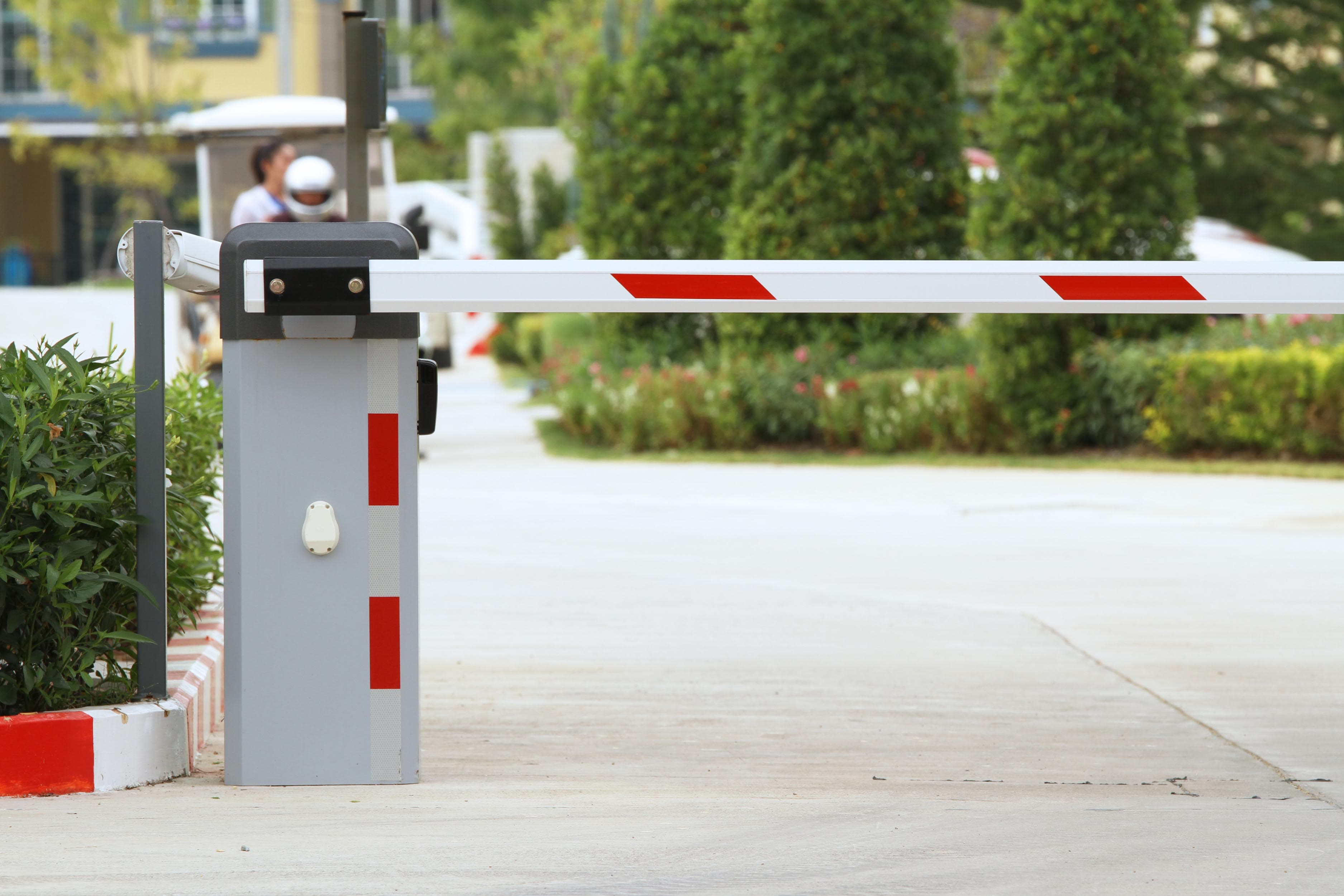
How Does a Boom Barrier Work?
What Is a Boom Barrier?
If you drive anywhere in the UAE you pass through several of these a day without thinking about them: the ramp down into a tower car park in Business Bay, the gatehouse of a villa compound, the truck lane at a logistics yard, the staff entrance at a hospital. A boom barrier (also called a barrier gate or boom gate) is the device that decides, each time, whether the lane opens.
It is a traffic control device rather than a crash protection device. That distinction decides what you should specify, and it is one of the more common misunderstandings in tender documents, so this page returns to it at the end.
The arm itself will not physically stop a determined vehicle. What the barrier actually delivers is a controlled, auditable decision point: nothing passes until the system has established that it is permitted to, and every passage is recorded with a timestamp. On a multi-tenant site (a mixed-use tower, a free-zone plot, a serviced community) that record is often more operationally valuable than the physical control itself.
How Does a Boom Barrier Work?
A boom barrier works in four stages. A sensor detects that a vehicle has arrived. An access method authorises it, an RFID tag, a recognised number plate, a ticket, or a guard pressing a button. The controller then drives a motor and gearbox that rotate the boom arm to the vertical position, where a limit switch or encoder stops it. After the vehicle passes, a safety loop or photocell confirms the lane is clear, and the controller lowers the arm.
Everything else on this page is detail beneath those four stages: detect, authorise, drive, confirm and close. The sequence is the same on a barrier in Fujairah as on one in Dubai Marina. What changes between sites is how the detection is done, how hard the environment pushes back on the hardware, and what the authority having jurisdiction expects of the installation.
Main Components of a Boom Barrier
| Component | Function |
|---|---|
| Barrier housing (cabinet) | Weather-resistant steel or aluminium enclosure holding the drive assembly, controller and manual release. In the UAE the finish specification deserves real attention: powder coating over correctly prepared and galvanised steel, or a marine-grade aluminium housing, rather than a standard outdoor finish. |
| Drive unit | Electric motor with a gearbox (electromechanical), or a pump and cylinder (hydraulic), providing the torque that turns the arm. |
| Crank and linkage | Converts the drive unit's rotation into the arm's 90-degree sweep. |
| Balance spring | A torsion or tension spring counterbalancing the arm's weight, so the motor moves a near-balanced load rather than lifting the full arm mass. Correct spring tension is central to smooth operation and motor life. |
| Boom arm | Aluminium octagonal, round or rectangular section, typically 3 to 6 metres. Optional skirt fencing, articulated joint for low headroom in basement ramps, or LED strip for night visibility. |
| Controller / control board | The logic of the system. Accepts open, close and safety inputs, drives the motor, manages timers, and communicates with access control or parking software. |
| Limit switches or encoder | Tell the controller when the arm has reached fully open or fully closed so the motor stops at the right point. |
| Loop detector | Electronics that sense a vehicle over a wire loop cut into the road surface. |
| Photocell / infrared beam | An optical beam across the lane that halts or reverses the arm if the path is obstructed. |
| Access control input | RFID reader, ANPR camera, ticket dispenser, push button, remote control or intercom, whatever grants the authorisation. |
| Manual release | A key-operated mechanism that disengages the drive so the arm can be raised by hand during a power failure. |
| Ventilation and thermal management | Filtered vents, a thermostatic fan or a cabinet layout that keeps the drive electronics out of direct solar gain. On an exposed lane in the UAE summer this moves from a refinement to a specification item. |
Drive unit and gearbox
Most barriers in commercial use are electromechanical: an AC or brushless DC motor turning a worm or helical gearbox. The gearbox provides the reduction that turns a fast, low-torque motor output into slow, high-torque arm movement, and its self-locking characteristic helps hold the arm in position. Higher-duty models use brushless DC motors with soft start and soft stop, which reduces mechanical shock at each end of travel and extends service life in lanes cycling thousands of times a day.
Brushless DC drives have a second advantage that matters more in this region than in temperate markets: they generally run cooler than comparable AC units at the same workload, and they tolerate a wider supply voltage band. Both characteristics help on an exposed gate in July and August, and the thermal point is picked up properly in the environment section below.
Boom arm and balance spring
The balance spring is the component most often misunderstood. It is not a safety device; it is a counterweight. Set correctly, the arm is close to neutrally balanced through its travel, so the motor does far less work and the barrier moves smoothly. Set incorrectly (commonly after an arm is replaced with one of a different length) the motor labours, travel becomes uneven, and the drive wears prematurely. Any change of arm length requires the spring tension to be reset.
Two UAE-specific notes on the spring. First, arm replacement is frequent here because arms get struck by delivery vehicles at high-turnover gates, so the reset discipline gets tested often. Second, the spring sits inside a housing that may be exposed to humid coastal air for years; a spring that has started to corrode will not behave the way its tension setting suggests, and it should be inspected rather than simply retensioned.
Controller and position sensing
The controller decides what happens and when. It holds the open and close timers, the logic for which inputs are permitted to trigger movement, the response to each safety device, and the interface to external systems. Position is confirmed either by mechanical limit switches at each end of travel or, on newer units, by an encoder reading the drive shaft continuously, which also allows the controller to detect that the arm has stalled against an obstruction.
Where a site has a fire alarm interface requirement, it is the controller that implements it. That input, and the behaviour it produces, is a life-safety matter rather than a convenience feature, and it is covered in the regulatory section below.
Detection and safety devices
These are covered in full in the two sections below, but the principle is worth stating early: detection devices decide when to open, safety devices decide when it is not permitted to close. Conflating the two is a common specification error, and it is visible in tender documents that list a single loop per lane and no photocell.
How Does a Boom Barrier Work Step by Step?
| Step | What happens | How it works |
|---|---|---|
| 1 | Vehicle approaches and is detected | An inductive loop buried in the road, or an IR, radar or camera sensor, registers the vehicle's presence at the entry point. |
| 2 | Credential is presented and read | A UHF RFID tag on the windscreen is read at range, a camera reads the number plate, a ticket is taken, a card is tapped, or a guard presses the open button. |
| 3 | Authorisation is decided | The credential is checked against the permitted list held in the controller, access control panel or parking software. A valid match produces an open command; an invalid one does not, and is logged as a denied attempt. |
| 4 | Controller energises the drive | The control board switches power to the motor. Soft start ramps it up to avoid jerking the arm. |
| 5 | Arm rotates to vertical | The gearbox and crank convert rotation into the arm's upward sweep, assisted by the balance spring. Typical travel is 1.5 to 6 seconds depending on arm length and model. |
| 6 | Open position is confirmed | A limit switch or encoder tells the controller the arm has reached full open, and the motor is stopped. |
| 7 | Vehicle passes through | The safety loop beneath the arm, and the photocell across the lane, both register the vehicle in the passage zone. |
| 8 | Lane is confirmed clear | The controller waits until the safety loop de-energises and the photocell beam is unbroken, meaning no vehicle remains under the arm. |
| 9 | Close is triggered | Either immediately on the lane clearing, or after a configured delay, or on an exit loop being crossed, depending on how the site is set up. |
| 10 | Arm lowers and the event is logged | The arm returns to horizontal and stops at the closed limit. The passage (credential, direction, timestamp, lane) is written to the access control or parking database. |
If an obstruction is detected at any point during step 10, the controller immediately stops and reverses the arm. This is the single most important behaviour in the cycle and is covered below.
One practical observation about step 9 on busy UAE sites. The close delay is frequently set too long during commissioning, because a long delay makes the gate feel forgiving. The consequence shows up later as tailgating on a tower ramp at shift change, and as an access log that no longer matches the number of vehicles in the car park. Close timing is worth tuning against the actual approach speed and lane length rather than left at a default.
How the Barrier Knows a Vehicle Is There
Inductive loop detectors
The inductive loop is the most widely used vehicle detector in UAE installations and the least visible, it sits inside the road surface. A loop of wire is cut into the asphalt or concrete in a rectangular or diagonal pattern and connected to a detector card. The card drives a small alternating current through the loop, which forms an oscillating circuit with a characteristic frequency.
When a large metal mass (a vehicle body) enters the loop's field, eddy currents induced in the metal alter the loop's effective inductance, shifting that frequency. The detector card senses the shift and outputs a presence signal. It detects the vehicle's metal mass, not its weight, which is why loops reliably detect cars and trucks but may not register a person or a bicycle.
A typical lane uses more than one loop with distinct jobs: an arming loop ahead of the barrier to wake the system or trigger the reader, a safety loop directly under the arm to prevent closing on a vehicle, and sometimes an exit loop past the barrier to confirm the vehicle has fully cleared and trigger the close.
Local surfacing conditions matter here. Asphalt at a surface car park in Al Quoz or at a yard in Mussafah softens considerably under peak summer surface temperatures, and heavy vehicle traffic over softened asphalt deforms the slot around a loop. The sealant chosen for the slot should be rated for the surface temperatures the site actually reaches, not a general-purpose product, and loops in heavy-truck lanes are usually better placed in a concrete apron than in asphalt.
RFID and long-range readers
For gated communities, corporate campuses, free-zone plots and labour accommodation where the same vehicles return daily, UHF RFID is the usual method. A passive tag (a windscreen sticker or a hard tag) carries an identifier but no battery. The reader's antenna radiates RF energy; the tag harvests enough of it to power its chip and reflect back its ID. Read ranges of several metres mean the vehicle is identified while still approaching, so the barrier is already opening as the driver arrives and no window needs to be lowered.
There is a useful adoption advantage in this market. UAE drivers are already accustomed to windscreen-tag vehicle identification through road tolling, so a windscreen tag on an access gate is an immediately familiar idea rather than something that has to be explained to every tenant and every driver. In practice that means less resistance when a community or a tower moves from guard-operated entry to tag-based entry, and fewer support calls about what the sticker is and why it must stay on the glass.
Two physical cautions that come up repeatedly. Metallised or heat-reflective windscreen film (common here for obvious reasons) can attenuate the signal to a passive tag, so tags are usually specified for on-glass mounting in a position agreed with the film type, or a hard tag is used instead. And a reader mounted where it bakes in direct afternoon sun will have a shorter life than the same reader under a canopy; the canopy is worth designing in.
ANPR number plate recognition
Automatic Number Plate Recognition uses a camera and optical character recognition to read the plate itself. An infrared-illuminated camera captures the plate (IR is used because retroreflective plates return it strongly and it works in darkness) and software locates the plate within the frame, segments the characters and converts them to text. That text is checked against the permitted list.
ANPR needs no tag in the vehicle, which makes it well suited to visitor traffic, short-stay car parks, and sites where issuing tags to every driver is impractical. Its accuracy depends on camera angle, mounting height, illumination, vehicle speed and plate condition.
In the UAE there are specific factors worth planning around. Plates are issued by individual emirates and vary in layout, character set and format, so the recognition engine and its permitted-list logic have to handle a mixed population of plates rather than a single national pattern, and sites close to the borders of neighbouring states also see visiting plates from outside the country. Strong direct sunlight produces glare and heavy shadow at certain hours on east- and west-facing approaches, and fine dust films on the camera window degrade capture quality before anyone notices visually. Most sites run ANPR alongside a fallback (an intercom, a guard, or a ticket) rather than relying on it alone.
Tickets, tokens and manual operation
Public and commercial car parks commonly issue a ticket or token at entry, which carries the entry timestamp for later tariff calculation by the parking operator's own system. Where traffic is low or highly varied (a villa compound gatehouse, a construction site entrance, a hotel service yard) manual operation by a guard using a push button, remote handset or intercom remains entirely legitimate, and on many UAE sites the guard post is staffed anyway for other reasons. Every automatic barrier retains a manual override regardless, which is what makes a mixed manual-and-automatic mode of working practical.
Electromechanical vs Hydraulic Boom Barriers
| Aspect | Electromechanical | Hydraulic |
|---|---|---|
| Drive method | Electric motor turning a gearbox and crank | Electric pump driving hydraulic fluid through a cylinder |
| Typical application | Tower and mall parking, offices, villa compounds, most commercial lanes | Long arms, very high duty cycles, port and industrial lanes |
| Arm length suitability | Shorter to medium arms | Handles longer and heavier arms more comfortably |
| Duty cycle | Suits low to medium cycling; high-duty variants available | Typically suited to continuous, high-frequency operation |
| Behaviour at high ambient temperature | Motor and gearbox heat must be shed from the housing; duty rating derates as ambient rises | Fluid viscosity changes with temperature; seal life is temperature-sensitive and fluid grade should match the climate |
| Maintenance profile | Mechanical wear points: gearbox, spring, limit switches | Fluid level, seals and hoses in addition to mechanical checks |
| Behaviour on power loss | Manual release key disengages the drive | Manual release valve bleeds pressure to free the arm |
The selection is driven by arm length, the number of cycles per day and the operating environment, not by a general notion that one type outperforms the other. A truck lane at a logistics yard running continuously through the night and a residential compound gate with a few hundred movements a day are genuinely different specification problems, and in this climate the thermal behaviour of each drive type belongs in that comparison rather than being treated as a footnote.
How Boom Barrier Safety Systems Work
Because the arm moves through a space that vehicles and people occupy, layered protection is standard. Each layer works differently, which is why competent installations use more than one.
- Safety loop: the loop directly beneath the arm. While it senses a vehicle, the controller is inhibited from closing. This is a presence interlock rather than a reaction: it prevents the close command rather than interrupting one.
- Photocell / infrared beam: a transmitter and receiver across the lane. If the beam is broken while the arm is lowering, the controller stops and reverses it. This catches what a loop cannot, including pedestrians, motorcycles and low-metal objects.
- Obstruction detection at the drive: the controller monitors motor current or encoder feedback. A sudden rise in load, or travel that stops when it should not have, is read as an impact and triggers a reverse.
- Manual release: allows the arm to be raised by hand in a power failure, so a lane never becomes permanently blocked. On a basement ramp this is not a convenience; a blocked ramp can trap vehicles below ground.
- Fire alarm interface: a monitored contact from the fire panel that drives barriers to open and hold, clearing vehicle egress routes during an evacuation. In the UAE this interface is a life-safety item that falls within the civil defence scope described in the next section, and it should be treated as part of the base design rather than as an option to be value-engineered out.
A practical note on photocells in this region: they are the safety device most often disabled or bypassed on site, usually after a period of false triggering caused by dust on the lens or by sunlight striking the receiver at a low angle. The correct response is to clean, realign, shade or reposition the device, and to use properly modulated photocells that reject ambient light. Bypassing a safety device to stop nuisance alarms removes the protection that device exists to provide.
Technologies Used in a Boom Barrier System
A modern barrier lane brings together several distinct technologies:
- Electromagnetic induction: loop detectors sensing vehicle presence through inductance shift.
- Passive UHF RFID: backscatter communication between reader antenna and unpowered windscreen tag.
- Optical character recognition with IR illumination: ANPR reading number plates in daylight and darkness.
- Motor control electronics: soft start and soft stop, current monitoring, and on some models variable-frequency drive.
- Position feedback: mechanical limit switches or rotary encoders confirming arm position.
- Optoelectronic sensing: modulated infrared photocells resistant to ambient light interference, which matters under high direct solar illumination.
- Network communication: TCP/IP, RS-485 or monitored contact interfaces to access control, parking and surveillance platforms.
- Environmental protection engineering: ingress protection ratings, gasket and seal materials, galvanising and coating systems chosen for a hot, humid, salt-bearing coastal atmosphere.
The Regulatory Context for Boom Barriers in the UAE
This is the part of barrier specification that differs most from other markets, and it is worth understanding before equipment is chosen rather than after. Nothing in this section should be read as a statement of current rules. Requirements differ between emirates, differ again inside free zones, and change over time. They must be confirmed per project with the relevant authority.
SIRA and the Dubai security regulatory framework
Security systems in Dubai, and the companies that supply and install them, operate within the regulatory framework of SIRA, the Security Industry Regulatory Agency. The practical consequence for a project team is that equipment selection and installer engagement in Dubai are a regulated matter rather than purely a commercial choice. A barrier lane that forms part of a site's security provision does not sit outside that framework simply because it is a mechanical device in a driveway.
What this means in planning terms is straightforward. Establish early, with the relevant authority, what applies to your site and your system type: which elements of the installation fall within scope, what is expected of the company carrying out the work, and what documentation the project will need to produce. Doing that at design stage is considerably less disruptive than discovering a requirement during handover. No supplier (including TimeWatch) should be understood as conferring regulatory status on a project, and no product should be described as approved or certified unless the issuing authority has said so in writing for that specific case.
Civil defence and how the barrier behaves on fire alarm
The life-safety aspects of an installation fall under civil defence authority, Dubai Civil Defence within that emirate, and the equivalent authorities elsewhere in the country. For a boom barrier the central question is behaviour on fire alarm: what the barrier does when the building's fire alarm system activates, how that signal reaches the barrier controller, whether the interface is monitored, and whether the arm opens and holds so that vehicles can clear the site and emergency appliances can enter.
Because this is a life-safety function, it should be designed as an interface between two systems rather than bolted on at the end as a pair of wires. The fire alarm contractor and the barrier installer need to agree the signal type, the fail-safe direction, the cabling route and the test method, and that agreement needs to be documented for the authority. The interface should then be tested as part of the site's scheduled fire drills, not only at handover. As with everything in this section, confirm the current expectations for your site with the authority having jurisdiction.
Abu Dhabi, the northern emirates and free zones
Abu Dhabi operates its own framework, administered by its own bodies, and it is not safe to assume that a package prepared for a Dubai project transfers unchanged to a site in Mussafah or on the islands. The northern emirates (Sharjah, Ajman, Umm Al Quwain, Ras Al Khaimah and Fujairah) each have their own municipal and civil defence arrangements, and a developer working across several emirates should expect to confirm requirements separately for each.
Free zones add a further layer. Zones such as Jebel Ali and Dubai South commonly apply their own site rules, permitting processes and contractor registration requirements on top of emirate-level regulation, and those rules are the ones that actually govern what happens at the plot boundary. For a logistics operator taking a warehouse in a free zone, the sequence that works is: establish the zone authority's requirements first, then the emirate-level requirements, then specify the equipment. Working in the other direction tends to produce rework.
How UAE Heat, Humidity and Dust Affect a Boom Barrier
A barrier is an outdoor electromechanical device that cycles continuously. In the UAE it does that in one of the more demanding combinations of conditions it will encounter anywhere: high ambient temperature, high humidity along the coast, salt-bearing air, intense solar radiation and periodic dust. Each of those does something different to the equipment, and specifying for one while ignoring the others is how sites end up replacing hardware early.
Duty derating at high ambient temperature
Summer ambient temperatures above 45°C are a normal design condition here, and surface and in-cabinet temperatures on an unshaded lane run higher still. A motor's duty rating (the number of cycles it can perform in a given period) is a thermal statement. It describes how much heat the motor can generate and shed before it reaches its limit. When the surrounding air is already hot, the motor sheds heat more slowly, so the same mechanical work produces a higher winding temperature and the usable duty falls.
The practical conclusion is blunt: a barrier chosen on its catalogue cycle rate will overheat on a high-traffic Dubai gate in August. The catalogue figure is typically quoted at a moderate reference ambient, and the lane will not be operating at that ambient for several months of the year. Specification should start from the site's peak hourly traffic, not its daily average, apply a derating margin for ambient temperature, and then select a drive with headroom above that figure, commonly a high-duty or industrial-duty model where a standard commercial unit would have looked adequate on paper.
Supporting measures help, and designing them in at the outset is far less disruptive than retrofitting them later: shading the housing from direct solar gain with a canopy; specifying a housing with effective ventilation or thermostatic forced cooling, with filtration appropriate to a dusty environment; avoiding dark housing colours on fully exposed lanes; and, where an installation cannot avoid a thermal corner, splitting traffic across two lanes so neither drive works at its limit.
Coastal humidity and salt-laden air
Heat alone derates the drive. Heat combined with high humidity and salt-laden air does something different and slower: it corrodes housings, fixings, hinge and linkage points, and (most damagingly) electrical terminations.
Most of the UAE's population and development sits within a short distance of the Gulf coast. Dubai Marina, the Jebel Ali area, the Sharjah and Ajman corniches, the Abu Dhabi islands and the Fujairah seafront are all coastal environments in the corrosion-engineering sense, and so are a great many inland-feeling sites a few kilometres back from the water. For the UAE as a whole, salt corrosion is close to a universal design condition rather than a special case reserved for beachfront projects.
That has consequences for specification:
- Housing material and finish: hot-dip galvanised steel with a quality coating system over it, or a suitable marine-grade aluminium. A painted mild-steel housing with no galvanising underneath will show rust bleed at edges and fixing points within a short service life near the coast.
- Fixings and foundation bolts: stainless steel of an appropriate grade, not plated carbon steel. Anchor bolts are a classic failure point because they sit at the wettest part of the installation, where wash-down water and condensation collect at the base plate.
- Electrical terminations: the most common corrosion-related fault. Humid salt air entering a cabinet through an unsealed gland reaches terminal blocks, connectors and PCB edge contacts and produces intermittent faults long before anything looks visibly failed. Correct gland selection, intact gaskets and a cabinet that is genuinely sealed where it claims to be are worth more than a higher headline IP rating on a housing whose door seal has been left loose.
- Loop feeder joints: any joint in a loop cable below ground must be made in a properly sealed, water-excluding manner. A joint that admits moisture in this climate will produce erratic detection that is then misdiagnosed as a detector card fault.
- Condensation management: on humid nights, cabinets that cooled below the dew point collect internal moisture. Breather arrangements and cabinet heaters are both used; the appropriate choice depends on the housing and the site.
Sand, dust and shamal events
Dust is a continuous, low-grade stressor, and the system tolerates it well until it does not. The usual symptoms are photocell false alarms from a filmed lens, accelerated wear of seals and bushings where fine particles act as an abrasive, and clogged ventilation filters that then push the thermal problem back onto the drive.
Dust loading is not uniform through the year. The fine dust that settles after a shamal wind event is a recognised maintenance trigger across the region: after a significant blow, photocell lenses, camera windows, cabinet filters and arm hinges across an estate all need attention at once, whether or not a scheduled service is due. Facilities teams that fold a post-event inspection into their routine see noticeably fewer nuisance faults in the following weeks than teams working to a fixed calendar alone.
Design responses are mostly straightforward: mount photocells where they are not in the direct line of wind-blown dust and where they can be reached for cleaning without a lane closure; prefer sealed bearings and protected linkages; specify filtered rather than open ventilation; and accept that camera windows and sensor lenses in this environment are a cleaning item, not a fit-and-forget item.
Where Boom Barriers Are Used in the UAE
Boom barriers appear anywhere vehicle movement needs to be controlled and recorded. In this market a handful of deployment types dominate:
- Free zones, ports and logistics: plot entrances, truck lanes and container yards around Jebel Ali Port and JAFZA, the Dubai South area, and Khalifa Port and KIZAD in Abu Dhabi. These are long-arm, high-cycle lanes, often with weighbridge and gate-pass integration, and they are among the most demanding duty applications in the country.
- Aviation and airport estates: staff and service vehicle access, cargo village gates, car park entries and airside support roads at Dubai International, Al Maktoum International and Zayed International. Here the barrier is normally the traffic-management layer, with the protective line provided by crash-rated equipment behind it.
- Malls and large mixed-use developments: high-turnover public car parks with ticketing or plate recognition, plus separate controlled entries for staff, tenants and service vehicles.
- Hotel and resort properties: guest arrival courts, valet lanes, back-of-house service yards and staff parking, all of which have different access populations and different tolerance for delay at the gate.
- High-rise residential towers: parking access control is a daily operational concern in towers in Business Bay, Dubai Marina and comparable districts, where a basement ramp is shared by residents, visitors, deliveries and valet operations and the barrier is the only point at which those flows can be separated and counted.
- Gated communities and villa compounds: a very common UAE deployment, typically residents on RFID windscreen tags with visitors handled at a guard post through intercom and visitor management.
- Labour accommodation and construction sites: where vehicle and workforce movement is tightly controlled, bus movements are scheduled, and the access record matters for site headcount and welfare management as much as for security.
- Industrial estates and workshops: the warehouse and workshop districts such as Al Quoz in Dubai and Mussafah in Abu Dhabi, where goods vehicle access, contractor control and yard movement all run through a small number of gates.
- Government and municipal facilities, universities and hospitals: regulated entry across large campuses, with priority lanes for emergency vehicles at hospitals and separation of public from staff parking.
- Parking operators and multi-storey car parks: high-cycle lanes paired with ticketing or automated identification, across all seven emirates.
TimeWatch supplies, installs and services boom barriers and associated parking and traffic control equipment for sites across the United Arab Emirates, from Dubai and Abu Dhabi through Sharjah and Ajman to Ras Al Khaimah, Fujairah and Umm Al Quwain.
Integration With Other Systems
A barrier rarely operates alone. Typical integrations on UAE sites:
- Access control: the same credential database governing doors and turnstiles also governs the vehicle gate, so one revocation closes every route. On a mixed-tenant tower this is what keeps a departed employee's parking access from outliving their building access.
- Parking management software: occupancy counting, bay allocation by tenant, tenant-wise and shift-wise reporting, and the data the operator needs to manage demand on a constrained basement.
- ANPR and long-range RFID readers: automatic identification, removing the need for driver interaction in high heat, which also matters for throughput when nobody wants to lower a window in August.
- Visitor management: a pre-approved visitor's vehicle recognised at the gate, with arrival notified to the host. Widely used at corporate towers, free-zone offices and gated communities.
- CCTV and video analytics: the camera bookmarks footage against each barrier event, so any passage can be reviewed from its log entry rather than by scrubbing recordings.
- Fire alarm systems: automatic open-and-hold on alarm, designed and documented as described in the regulatory section above.
- Weighbridges and gate-pass systems: in logistics, port-adjacent and industrial sites, the barrier releases only once the weighment and the gate pass are complete and recorded.
- Building management and lift systems: on some tower projects, a recognised resident vehicle entering the basement can trigger downstream building functions, which is a software integration rather than a barrier function but is specified at the same time.
Installation Considerations
Most barrier problems trace back to installation rather than the equipment. The principal considerations, with the UAE-specific ones called out:
- Foundation: a level concrete plinth with correctly positioned anchor bolts, raised enough that wash-down water and run-off do not pond at the base plate. An out-of-level housing causes uneven travel and premature wear.
- Loop cutting: the slot must be cut to correct depth and width, the wire laid with the specified number of turns, and the slot sealed with a product rated for local surface temperatures so it does not soften and admit water. Loop faults are among the most frequent causes of erratic behaviour, and almost all are workmanship issues.
- Loop positioning: arming, safety and exit loops each need to sit in the right place for the lane geometry and the expected vehicle lengths, which on a port or logistics lane means designing around articulated vehicles rather than cars.
- Cable routing and separation: loop feeder cables should be twisted and routed away from power cabling to limit interference, and all below-ground routes should be in conduit with sealed, water-excluding joints.
- Earthing and surge protection: outdoor electronics on long cable runs are exposed to induced surges and to supply disturbances; proper earthing and surge arrestors materially affect reliability.
- Solar shading and orientation: where the lane layout allows, position the housing, reader and camera so they are not in full afternoon sun, or provide a canopy. This single decision affects drive duty, reader life and ANPR capture quality at once.
- Corrosion specification: galvanising, coating system, fixing grade and gland selection agreed at design stage against the site's distance from the coast, not chosen on site by whoever is installing.
- Arm length and headroom: the arm must cover the lane without over-swinging into obstructions. Basement ramps and low canopies, common in UAE towers, frequently call for an articulated arm.
- Power supply: stable supply, with battery or UPS backup where the gate must keep working through an outage. On a basement ramp this should be assumed rather than debated.
- Camera positioning for ANPR: mounting height, angle and distance determine plate capture reliability across the mix of emirate plate formats the site will see, and should be set during design rather than adjusted afterwards.
- Authority coordination: permitting, approvals and any required documentation for the emirate and, where applicable, the free zone, confirmed before equipment is ordered.
Maintenance Considerations
Barriers are mechanical devices in an outdoor environment, cycling continuously. In this climate routine attention is what separates a lane that runs for years from one that produces monthly call-outs:
- Inspect and lubricate the drive mechanism and linkage at the manufacturer's interval, using a lubricant that holds up at local temperatures rather than running out of the bearing in summer.
- Check balance spring tension, inspect the spring for corrosion, and always reset tension after an arm change.
- Verify limit switch or encoder positions so the arm stops cleanly at both ends.
- Clean photocell lenses and camera windows and confirm alignment. Dust films, spider webs and insect nests are common causes of false obstruction detection.
- Carry out an additional inspection after any significant dust or shamal event, outside the normal schedule.
- Open the cabinet and inspect terminations, glands and gaskets for corrosion, discoloration or moisture ingress, the single most useful preventive check on a coastal site.
- Confirm cabinet ventilation filters are clear, particularly before the summer peak.
- Test loop continuity and insulation, particularly after any road resurfacing or trenching work on the approach.
- Confirm the manual release operates, and that the key is where the site team can find it, before it is needed.
- Test the fire alarm interface as part of scheduled fire drills and record the result.
- Inspect the arm for impact damage and confirm reflective strips or LEDs remain visible at night.
Benefits and Limitations
Benefits
- Controlled, recorded vehicle access without permanent manual staffing at the point of entry.
- Fast throughput, sub-two-second opening on suitable models keeps queues moving at busy gates, which matters on tower ramps and mall entries at peak.
- A complete audit trail of entries and exits by credential, direction and time, which multi-tenant and free-zone operators generally need for their own reporting.
- Integrates with access control, parking, CCTV and visitor systems so vehicle and pedestrian movement share one record.
- Drivers can be identified without lowering a window, which is a genuine comfort and throughput advantage for several months of the year.
- Deters casual unauthorised entry and enforces bay allocation in constrained car parks.
Limitations and considerations
- It is not a security barrier in the protective sense. A boom arm will not stop a vehicle driven through it deliberately. Where hostile vehicle mitigation is the requirement, crash-rated bollards or road blockers are the correct equipment, with the boom barrier handling routine traffic in front of them.
- Tailgating is possible: a second vehicle can follow closely before the arm lowers. Sites needing strict one-vehicle-per-authorisation control pair the barrier with loop-based sequence logic or CCTV verification.
- ANPR accuracy varies with plate condition, glare, dust on the camera window, lighting and vehicle speed, and across a mixed population of emirate plate formats. It needs a fallback path.
- Loop detectors are embedded in the road, so resurfacing, heavy vehicle damage to softened asphalt, or water ingress at a joint can disturb them, and repair means cutting the surface again.
- Duty cycle must match the site at local ambient temperature, not at the catalogue reference condition. A barrier specified for light use will fail early in a high-throughput lane here.
- Corrosion is cumulative and quiet. The damage done by humid, salt-bearing air shows up as intermittent electrical faults long before anything looks obviously wrong, so inspection of terminations needs to be deliberate rather than visual from outside.
- Regulatory requirements are not uniform. What satisfies one emirate or free zone may not transfer to another, and requirements change, so each project needs its own confirmation.
Exact behaviour (opening time, safety response, integration options and duty rating) depends on the specific model, controller, software and site configuration. Detailed figures should always be confirmed against the datasheet for the equipment being specified, and derated for the conditions in which it will actually operate.
Boom Barrier vs Bollard: What Is the Difference?
| Aspect | Boom barrier | Security bollard |
|---|---|---|
| Primary purpose | Traffic control and access recording | Physical vehicle impact protection |
| Stops a hostile vehicle | No | Yes, when crash-rated to a recognised standard |
| Typical cycle speed | Fast, typically suited to high-volume lanes | Slower for hydraulic rising types; fixed types do not move |
| Lane coverage | Spans the full lane with one arm | Multiple units set across the opening |
| Common pairing | Handles routine traffic | Sits behind or alongside the barrier for protection |
| Typical UAE context | Tower and mall parking, communities, free-zone plots, logistics yards | Government and diplomatic premises, critical infrastructure, airport landside frontages, high-profile public buildings |
The two are complements, not alternatives. Sites with a protective requirement routinely install both: the barrier manages everyday flow and keeps the queue moving, and the bollards provide the protective line behind it.
Frequently Asked Questions
How does a boom barrier detect a car?
Most barriers detect vehicles using an inductive loop buried in the road. The loop carries an alternating current; when a vehicle's metal mass enters its field, the loop's inductance changes and the detector card registers a presence. Some installations instead use infrared, radar or camera-based detection.
What is a loop detector in a boom barrier?
A loop detector is the electronic card connected to a wire loop cut into the road surface. It senses the change in the loop's inductance when a vehicle passes over it and outputs a presence signal to the barrier controller. A single lane commonly uses separate loops for arming the system, preventing closure on a vehicle, and confirming the vehicle has exited.
How long does a boom barrier take to open?
Typically between 1.5 and 6 seconds, depending on arm length, drive type and model. Shorter arms on high-speed units open fastest; long arms and heavy-duty industrial barriers take longer. The exact figure is a specification of the individual model.
Can a boom barrier stop a vehicle?
No. A boom barrier is a traffic control device, not a crash barrier. Its arm will break if a vehicle is driven through it. Where physically stopping a vehicle is the requirement, crash-rated bollards or road blockers are the appropriate equipment.
What happens if a boom barrier hits a car?
A correctly configured barrier should not. The safety loop under the arm prevents closing while a vehicle is present, and a photocell beam across the lane stops and reverses the arm if the path is obstructed. Controllers also monitor motor load or encoder feedback and reverse on detecting unexpected resistance. If a strike does occur, the usual cause is a misaligned photocell, a dust-filmed lens, a faulty loop or a safety device that has been bypassed.
Do boom barriers in Dubai fall under SIRA regulation?
Security systems in Dubai, and the companies that supply and install them, operate within the regulatory framework of the Security Industry Regulatory Agency, so equipment selection and installer engagement are a regulated matter rather than purely a commercial decision. What applies to a particular barrier installation depends on the site and the system type. Requirements also differ between the emirates and change over time, so a project team should confirm the current position directly with the relevant authority rather than relying on general guidance.
How do high temperature, humidity and salt air in the UAE affect a boom barrier?
Three separate effects. High ambient temperature reduces the motor's usable duty, because heat is shed more slowly into already hot air, so a barrier chosen on its catalogue cycle rate can overheat on a busy lane in summer. High humidity combined with salt-laden coastal air corrodes housings, fixings and especially electrical terminations, which is why galvanising, stainless fixings and properly sealed glands matter. Airborne dust films photocell lenses and camera windows and wears seals. Most UAE development sits close to the coast, so corrosion protection is a routine design condition rather than a special case.
Does a boom barrier work during a power failure?
Not automatically, unless it is on a UPS or battery backup. Every barrier includes a manual release, usually a key-operated mechanism that disengages the drive so the arm can be lifted by hand. Sites that cannot tolerate a blocked lane, such as a basement ramp in a tower, should specify battery backup at the design stage.
What is the difference between an electromechanical and a hydraulic boom barrier?
An electromechanical barrier uses an electric motor and gearbox to move the arm. A hydraulic barrier uses a pump and cylinder. Electromechanical units suit most commercial and parking applications; hydraulic units are generally selected for longer arms, heavier duty and very high cycle counts such as port and logistics lanes. Hydraulic systems add fluid, seal and hose maintenance to the routine, and the fluid grade should suit the local temperature range.
Can a boom barrier work with RFID and number plate recognition together?
Yes, and many sites use both. Regular vehicles carry UHF RFID windscreen tags read at several metres, while visitor vehicles are handled by ANPR or by a ticket issued at the gate. The controller accepts authorisation from either source, so residents or staff pass without stopping while visitors are still managed. Drivers in the UAE are already familiar with windscreen-tag vehicle identification from road tolling, which makes tag-based gate access easy to introduce to tenants.
How is a boom barrier integrated with access control software?
The barrier controller connects to the access control or parking platform over TCP/IP, RS-485 or monitored contacts. The software holds the permitted credential list and decides each open command, then records the passage with credential, direction, lane and timestamp. Because doors, turnstiles and vehicle gates share one credential database, revoking a person's access closes every route at once.
