
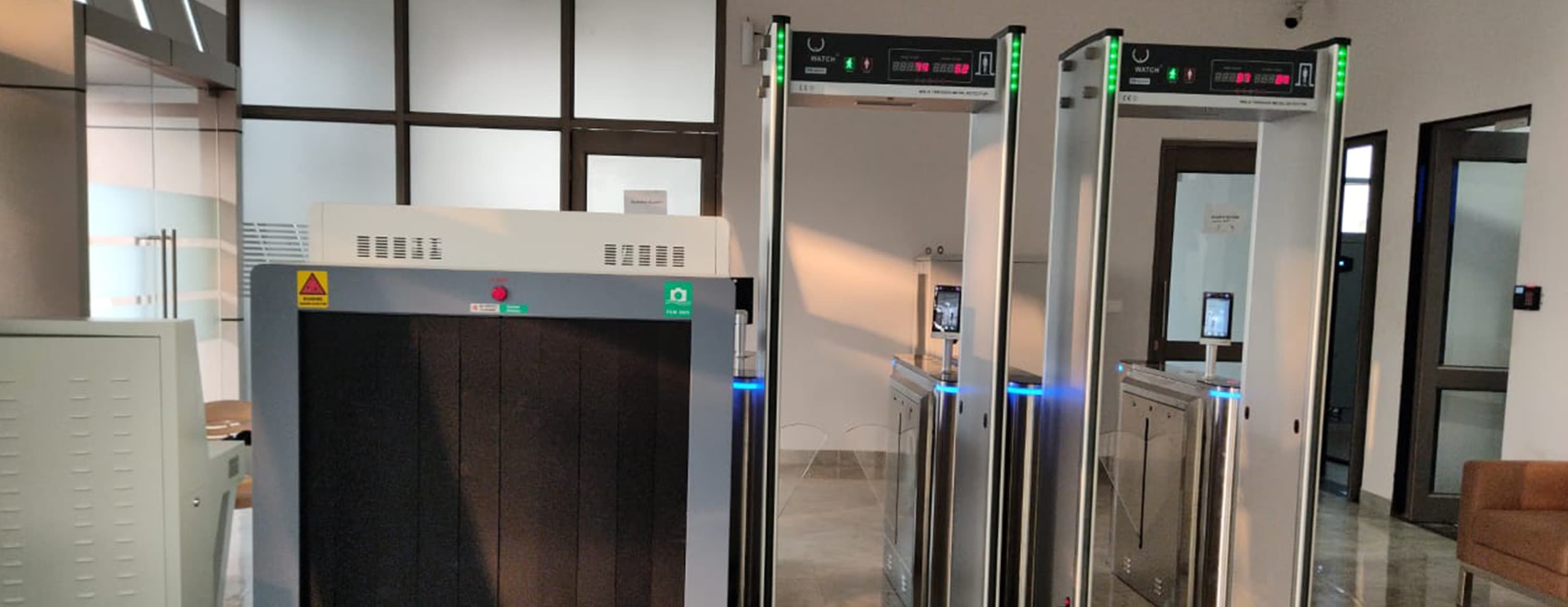
How Does a Body Scanner Work?
What Is a Security Body Scanner?
Most people in the UAE meet one of these at an airport, and increasingly at the entrance to a large venue or a government building. It is also called a full body scanner or a people screening portal. It stands in the same lane as a walk-through metal detector and an X-ray baggage scanner, but it answers a different question from either of them.
The archway asks whether there is metal on this person. The scanner asks whether there is anything on this person's body surface that does not look like body surface. That is why the two are specified together rather than as alternatives: an archway cannot respond to a ceramic edge, a moulded composite shape or a packed powder, because none of them is conductive metal, while a scanner responds to physical shape regardless of what the object is made of.
One more distinction is worth making early, because it governs how the equipment should be described in a tender. A body scanner is an indication device, not an identification device. It produces a flag over a region, and a trained operator establishes what is actually there. Any specification implying that the machine names the object is wrong, and a technical evaluator will read that wording as a weakness in the submission rather than a strength.
How Does a Body Scanner Work?
An active millimetre wave body scanner works by transmitting low-power, non-ionising radio energy in the millimetre wavelength band towards the person standing in the portal. Clothing is largely transparent at these wavelengths, so the energy passes through fabric and reflects off the skin and off any object between the skin and the clothing. Receiver antennas capture those reflections as the array sweeps around the body or steers electronically across it. A signal processing unit reconstructs a three-dimensional representation of the body surface from the timing and strength of the returns. Automatic target recognition software then analyses that reconstruction for regions departing from an expected body contour, and displays a generic outline with a marker over any flagged region so the operator resolves only that area.
The scan takes a few seconds and the person stands still in a defined pose throughout. The sequence is identical at an airport in Abu Dhabi and at a stadium entrance in Sharjah. What differs between sites is the regulatory framework the installation sits inside, how the lane around the portal is designed, and how hard the local environment pushes back on the hardware.
The Three Body Scanning Technologies
Three physically different approaches have been used to screen people, and they are routinely discussed as one category. That is the source of almost all the confusion on the safety question, because on radiation the three are not comparable at all.
Active millimetre wave
This is the dominant technology for passenger screening and the one a UAE project is most likely to be evaluating. An antenna array transmits radio energy in the millimetre band at low power. The wavelength is short enough to resolve objects of a useful size and long enough that clothing is largely transparent to it, that combination is what makes the technique possible. The energy reflects from the skin, and differently again from materials lying against or near it.
By capturing reflections from many positions around the body, either by rotating an array around the person or by switching electronically between a large number of fixed antenna elements, the system assembles returns from which a three-dimensional surface can be reconstructed. Millimetre wave energy of this kind is non-ionising, and the technology does not use X-rays.
Passive millimetre wave
A passive system transmits nothing at all. It senses millimetre wave energy naturally emitted and reflected by the body and its surroundings, in broadly the same sense that a thermal camera senses emitted infrared. An object concealed under clothing alters the emission pattern reaching the sensor, and the system detects that alteration.
Because passive systems emit nothing, they avoid the transmission question entirely, and some designs operate at a stand-off distance rather than requiring the person to step into a portal, which has obvious appeal at venue approaches where stopping every individual would be impractical. Detection performance differs from active systems and is strongly equipment-specific, so capability should be taken from the datasheet for the model being evaluated rather than from a general description of the technology.
Backscatter X-ray and the ionising radiation distinction
Backscatter systems direct a low-dose X-ray beam at the body and detect the X-rays scattered back from the surface rather than those transmitted through it, which produces a surface representation rather than a medical-style internal one.
The distinction that matters to a specifier is absolute: backscatter uses ionising radiation and millimetre wave does not. That is precisely why the use of backscatter systems for passenger screening has been restricted or withdrawn in a number of jurisdictions on radiation and privacy grounds, and why millimetre wave is now far more common for screening people. Any organisation in the UAE considering X-ray-based people screening must establish the applicable regulatory position for that technology in this jurisdiction before going further, it is a regulatory question with a defined owner, not an engineering preference.
What Is Automatic Target Recognition (ATR)?
Automatic target recognition is the feature that made this technology deployable in public, and it is the most misunderstood aspect of body scanning. For a UAE venue operator it is also the feature that decides whether the equipment can be used at all in a setting where guests are the people being screened.
In an ATR system the reconstructed three-dimensional data is never displayed to the operator. Detection algorithms analyse it for regions departing from an expected body contour, and the operator's screen shows a generic outline or avatar (the same stylised figure for every person screened, carrying no individual physical detail) with a box over the region where an anomaly was found. If nothing is flagged, the screen shows a clear result and nothing else.
The significance is easy to miss. The detection physics did not change when ATR arrived; the scanner senses exactly what it sensed before. What changed is how the output is presented, and that is what made the technology acceptable for public screening. Before generic-avatar display, the privacy objection was severe enough to block deployment in several places and to force the removal of installed equipment in others. ATR did not answer the objection by arguing with it, it removed the thing being objected to.
Anyone specifying a scanner for a UAE site should treat ATR-only display as a baseline requirement rather than a feature to compare between bidders, and should obtain written confirmation that the equipment has no operator-accessible mode capable of displaying anything other than the generic avatar. That belongs in the technical submission, not in a conversation at handover.
Main Components of a Body Scanner
| Component | Function |
|---|---|
| Portal or panel assembly | The physical structure the person stands within or beside. Defines the scan volume and the standing position. In a hotel or retail setting its appearance and footprint are part of the specification rather than an afterthought. |
| Transmitter antenna array | Emits millimetre wave energy towards the body. Absent in a passive system, which transmits nothing. |
| Receiver antenna array | Captures reflected or naturally emitted energy. On many designs the transmit and receive elements are combined into transceiver modules. |
| Scanning mechanism or electronic steering | Moves the array around the body, or switches electronically between many fixed elements to achieve the same angular coverage with no moving parts. Designs without moving parts need less attention in a dusty environment. |
| Signal processing unit | Digitises the returns and reconstructs the three-dimensional representation of the body surface. |
| ATR software | Analyses the reconstruction for anomalies and decides what to flag. The behaviour of the whole system is largely determined here rather than in the antenna hardware. |
| Operator display | Shows the generic avatar with flagged regions, or a clear indication. Must be positioned so queuing guests and passers-by cannot read it, in an open lobby that is a harder siting problem than in a terminal. |
| Control interface | Operator controls for initiating a scan, recording the resolution outcome and managing operating modes. Configuration access is password-protected and should sit with a named role. |
| Guidance indicators | Lights, floor footprints and on-screen prompts showing where to stand and what pose to adopt. In a population of residents, tourists and transit passengers speaking many languages, these carry more throughput than their simplicity suggests. |
| Environmental protection and thermal management | Enclosure sealing, filtration and cooling that keep the electronics inside their rated band. At a semi-open entrance or a portal near an automatic door in summer this becomes a functional component. |
| Power supply and conditioning | Mains input with conditioning; backup arrangements follow the site's continuity requirement, which at an airport or a major venue is normally stricter than the building default. |
How Does a Body Scanner Work Step by Step?
| Step | What happens | How it works |
|---|---|---|
| 1 | Person divests metal and pocket contents | Coins, keys, phones, belts and similar items are removed. Items left in pockets are the commonest cause of an avoidable anomaly flag, and the divestment step is where lane throughput is won or lost. |
| 2 | Person enters the portal and stops | Unlike an archway, the scan requires the person to stand still within a defined position, normally marked on the floor. |
| 3 | Required pose is adopted | Typically arms raised and held slightly away from the body, so the arms do not shadow the torso and sides from the array. |
| 4 | Scan is initiated | The operator or an automatic sequence starts the scan once the person is correctly positioned. |
| 5 | Energy is transmitted towards the body | The array emits low-power millimetre wave energy. Clothing is largely transparent at these wavelengths, so the energy reaches the skin. A passive system omits this step and senses naturally emitted energy instead. |
| 6 | Reflections are produced | Energy reflects from the skin surface and from any object between the skin and the clothing, with characteristics depending on the object's material and shape. |
| 7 | Array sweeps the body | The array rotates around the person or steers electronically, so reflections are captured from many angles rather than one. |
| 8 | Returns are captured and digitised | Receiver antennas collect the reflections; the signal processing unit converts them into data carrying position and intensity information. |
| 9 | Three-dimensional reconstruction | The processing unit assembles the returns into a representation of the body surface and of anything sitting on it. |
| 10 | ATR analyses for anomalies | Detection algorithms compare the reconstruction against an expected body contour and flag regions that depart from it. |
| 11 | Generic avatar is displayed | The operator sees a standard outline figure with a box over each flagged region, or a clear result. No body image is displayed at any point. |
| 12 | Targeted resolution or release | If a region is flagged, the operator resolves that location only, commonly with a handheld detector or a localised check under the site's documented procedure. If nothing is flagged, the person proceeds. |
Steps 5 to 11 take seconds and are identical everywhere. Steps 1 and 12 are designed by the operating organisation, differ at every site, and are where virtually every throughput and guest-experience problem originates. A venue that invests in the portal and improvises the divestment and resolution procedures around it will have a slow lane and an unhappy queue regardless of which model it bought.
What the System Indicates, and What It Does Not
Metallic and non-metallic anomalies
The advantage over an archway is that the scanner is not restricted to conductive metal. Because it responds to what is physically present between the skin and the clothing, it can indicate anomalies that are metallic and non-metallic alike, and the non-metallic case is exactly where a walk-through detector has nothing to contribute. That is the operational reason a scanner is added to a lane that already contains an archway.
An anomaly is not a threat
The system flags a region that does not look like body surface. It does not establish what is there. That is done by the operator at the resolution stage through a targeted check. No screening device of this type detects any specific threat with certainty, and a datasheet or tender response implying otherwise should be challenged rather than accepted at face value.
It also screens the body surface only, not the body's interior and not carried bags. Bag contents belong to the X-ray scanner on the parallel belt. Neither device substitutes for the other, and a venue that removes one because it has the other has reduced its coverage rather than consolidated it.
Where nuisance flags come from
Body scanners flag ordinary things constantly. Operators who have not been told to expect this lose confidence in the equipment quickly, and in a guest-facing setting that shows up as inconsistent handling at the lane. The usual sources are thick clothing folds and bunched fabric at the waist or shoulders, heavy seams, sweat, bandages, prosthetics, orthopaedic supports, insulin pumps and other worn medical devices, and items simply left in a pocket. None of these is a threat, and all of them can legitimately produce a region that does not match an expected body contour, because none of them is body contour.
Two rules follow. Resolution should be targeted at the flagged region rather than expanded into a general search, and the flagged-anomaly rate should be tracked as a number. A rate drifting upward at a particular entrance almost always points at a divestment procedure that has quietly stopped being enforced rather than at equipment that has become more sensitive.
Throughput: Why the Scanner Sits Behind the Archway
This is the operational reality specifications underestimate most often, and it drives entrance design far more than any detection parameter does.
A walk-through metal detector screens people at walking pace and nobody stops. A body scanner requires the person to stop, step into a marked position, adopt a pose, hold it while the scan completes, step out and wait for a result. That is several times longer per person than an archway pass, and pose compliance is difficult to achieve consistently across a mixed public queue, in several languages, with luggage, children and guests who have never seen the device before.
So a body scanner is almost never primary screening for everyone. It is used as selective or secondary screening: everyone passes the archway, and a proportion (those who alarm, those selected under a defined procedure, or those in a defined screening category) is directed to the scanner. A venue that specifies a scanner as the universal first line will need a great many units, or will produce a queue at its own front door that becomes a crowd-management problem in its own right. At a mall entrance on a weekend evening or a stadium gate before kick-off, that is not a theoretical risk.
The Regulatory Context for People-Screening Equipment in the UAE
This is the part of screening specification that differs most from other markets, and it is worth understanding before equipment is selected rather than afterwards. Nothing in this section states current rules. Requirements differ between emirates, differ again inside free zones, and change over time. They must be confirmed per project with the relevant authority.
SIRA and the Dubai security regulatory framework
Security systems in Dubai, and the companies that supply and install them, operate within the regulatory framework of SIRA, the Security Industry Regulatory Agency. The practical consequence for a project team is that equipment selection and installer engagement in Dubai are a regulated matter rather than purely a commercial choice. A screening portal at a building entrance does not sit outside that framework because it is a visitor-facing device in a lobby; if it forms part of the site's security provision, it falls to be considered within it.
What this means in planning terms is straightforward. Establish early, with the relevant authority, what applies to your site and your system type: which elements of the installation are in scope, what is expected of the company carrying out the work, and what documentation the project must produce. Doing that at design stage is considerably less disruptive than discovering a requirement during handover. No supplier (including TimeWatch) confers regulatory status on a project, and no product should be described as approved or certified unless the issuing authority has said so in writing for that specific case.
Civil defence, egress and the screening position
The life-safety aspects of an installation fall under civil defence authority, Dubai Civil Defence within that emirate, and the equivalent authorities elsewhere in the country. For a screening position the questions are different from those raised by a barrier or a turnstile, but no less important: where the lane sits in relation to escape routes, what happens to the screening arrangement during an evacuation, whether the queue and the hold area obstruct egress when the entrance is at its busiest, and how the screening position behaves if the building's alarm activates.
Because this is a life-safety matter rather than a security convenience, it should be designed as an interface between the entrance layout and the building's evacuation strategy, agreed with the fire and life-safety consultant, and documented for the authority. It should then be exercised as part of the site's scheduled drills, a screening lane full of divestment trays and queuing guests behaves very differently in a drill than it does on a layout drawing. As with everything in this section, confirm the current expectations for your site with the authority having jurisdiction.
Abu Dhabi, the northern emirates and free zones
Abu Dhabi operates its own framework, administered by its own bodies, and it is not safe to assume that a package prepared for a Dubai project transfers unchanged to a site in Mussafah or on the islands. The northern emirates (Sharjah, Ajman, Umm Al Quwain, Ras Al Khaimah and Fujairah) each have their own municipal and civil defence arrangements, and an operator working across several emirates should expect to confirm requirements separately for each.
Free zones add a further layer. Zones such as Jebel Ali and Dubai South commonly apply their own site rules, permitting processes and contractor registration requirements on top of emirate-level regulation, and those are the rules that actually govern what happens at the plot boundary. For a logistics or aviation operator inside a zone, the sequence that works is: establish the zone authority's requirements first, then the emirate-level requirements, then specify the equipment. Working in the other direction tends to produce rework.
Screening Guests Without Spoiling the Visit
A great many UAE screening positions are not at an airport. They are at hotel entrances, mall doors, resort gates, exhibition halls and stadium concourses, where the people being screened are guests and customers rather than passengers who have accepted screening as part of travelling. The security requirement is real; so is the fact that the entrance is the first thing a guest experiences. Those two things have to be designed together, and this is the part of the brief most often left to whoever is standing at the door on opening day.
Where the scanner goes and what the guest sees
A scanner is a stop-and-pose device, so placing it in the main flow of an entrance guarantees a queue. The arrangement that works is an archway carrying the full stream at walking pace, with a discreet diversion to a scanner set slightly out of the main line, and a hold area sized so that resolving one person does not stall everyone behind them. The operator display must not be readable from the queue, in a glass-fronted lobby with people standing at several levels, that is a harder siting problem than it looks on a plan, and it is worth checking from standing eye level in the actual queue position rather than from the operator's chair.
Signage is part of the design rather than an afterthought. A short, plainly worded sign in Arabic and English stating that the operator sees a generic outline and not an image of the person answers the question most guests are actually asking, and it answers it before anyone has to ask a member of staff.
The divestment conversation
Almost every avoidable flag comes from something in a pocket. A divestment procedure that is explained clearly, with somewhere to put belongings and somewhere to collect them, removes most nuisance flags before they happen and is the single most effective thing a venue can do for both throughput and guest experience. Where a venue runs a bag X-ray alongside, the divestment and reclaim points should be designed as one movement rather than two.
Staff language matters as much as layout. A flagged region means the operator needs to check one location, and staff should be trained to say exactly that, calmly, in the guest's language where possible. Anyone with an implanted medical device, a prosthetic, an orthopaedic support or a specific medical concern should be able to say so before the scan, discreetly and without joining a different queue, and should be offered an alternative screening method without having to ask twice. They should also be advised to follow their doctor's advice and the guidance supplied with their device, that is not the venue's judgement to make.
Treating the flagged-anomaly rate as a service measure
Venues that run screening well track the proportion of scans that produce a flag and review it alongside queue times, not separately from them. A rising rate at a particular entrance is almost never a change in the equipment; it is usually a divestment procedure that has lapsed, a shift pattern with weaker briefing, or a new uniform or dress code that interacts with the lane in a way nobody anticipated. Reviewing that number monthly turns a recurring guest complaint into an operational fix.
How UAE Conditions Affect a Body Scanner
Screening equipment is usually described as indoor equipment, and inside a conditioned terminal it is. A large number of UAE screening positions are not quite that: entrances where automatic doors open repeatedly onto outside air, covered but unconditioned venue concourses, temporary event screening points, gatehouses at logistics and industrial plots. Those are the positions where environment becomes a specification question rather than a background condition.
Heat and the equipment enclosure
Summer ambient above 45°C is a normal design condition here, and inside an enclosure at a semi-open entrance the air around the electronics is hotter still. Every manufacturer states a permissible operating temperature and humidity band, and those bands are specifications rather than guidance, equipment run outside them may shut down, may behave unpredictably, or may simply have a shorter service life than the project assumed.
This is a layout and services question, so it has to be settled at design stage. Measure or model the actual temperature at the proposed position during the hot part of the day rather than relying on the building's design figure; provide conditioning or shading where the band cannot otherwise be held; keep the enclosure out of direct solar gain through glazed frontages, which is a common oversight in lobbies designed for daylight; and commission in realistic conditions. A screening position signed off at eight in the morning in January has not been tested.
Coastal humidity and salt-laden air
Most UAE development sits close to the Gulf coast. Dubai Marina, the Jebel Ali area, the Sharjah and Ajman corniches, the Abu Dhabi islands and the Fujairah seafront are all coastal environments in the corrosion-engineering sense, and so are many sites that feel inland a few kilometres back from the water. For the UAE as a whole, salt corrosion is close to a universal design condition rather than a special case for beachfront projects.
On screening equipment the damage appears first at electrical terminations, connectors and exposed fixings, and it appears as intermittent faults long before anything looks visibly wrong. Where a screening position is exposed to outside air (a lobby with frequently opening doors, a covered concourse, a gatehouse) specify enclosure material and finish for the exposure, use fixings of an appropriate grade, seal cable entries properly, and make internal inspection of terminations a deliberate item at service visits rather than a visual check from outside. Where the exposure is genuine, confirm the arrangement with the manufacturer for the specific model rather than assuming the standard build covers it.
Fine dust and shamal events
Dust is a continuous, low-grade stressor and the system tolerates it until it does not. It settles inside the enclosure where it insulates components that need to shed heat, loads ventilation and filter media so the thermal design quietly stops holding, and accumulates on the operator display and any optical guidance device so staff see less than they should.
Dust loading is not uniform through the year. The fine dust that settles after a shamal wind event is a recognised maintenance trigger across the region: after a significant blow, filter media, enclosure surfaces and display screens across an estate all need attention at once, whether or not a scheduled service is due. The table below is a workable way to set intervals from the position rather than from the calendar.
| Screening position | Dominant stress | Attention pattern typically suited to it |
|---|---|---|
| Conditioned terminal or building interior, steady throughput | Throughput and operator drift rather than environment | Functional test routine at the manufacturer's stated interval, with operator refresher training and a review of the flagged-anomaly rate at each service. |
| Lobby or concourse with frequently opening doors to outside air | Intermittent heat and humidity ingress, fine dust | Shorter filter and enclosure cleaning intervals than the manufacturer's default, plus a check that the position still holds the stated temperature band after any change to the entrance layout or door control. |
| Covered but unconditioned entrance, gatehouse or plot access point | Thermal load inside the enclosure plus dust | Filter, vent and enclosure interior cleaning treated as scheduled items in their own right, ahead of the main service; display cleaning on a shorter cycle again. |
| Coastal position with genuine exposure to outside air | Salt-laden humidity in addition to heat and dust | Internal inspection of terminations, connectors and fixings at every visit, with early attention to any coating or seal damage before it spreads. |
| Temporary or event screening point | Rapid deployment, uncontrolled surroundings, short intense load | Full functional check on deployment and on removal, with the environmental band confirmed at the actual position rather than assumed from the permanent installation it was borrowed from. |
After any significant dust event an additional inspection is justified regardless of where the site sits in its schedule. Filters, enclosure surfaces and the operator display are the first three items, and all three take minutes.
Where Body Scanners Are Used in the UAE
- Aviation: the principal application, with selected passengers directed to a scanner alongside archway and baggage screening at Dubai International, Al Maktoum International and Zayed International, and staff and crew screening handled under separate procedures at the same facilities.
- Large venues and major events: stadium gates, arena concourses and exhibition halls, where the scanner is a secondary position behind archway screening and where the entrance has to clear a very large crowd inside a narrow window.
- Government, municipal and diplomatic facilities: controlled entry at designated entrances where the threat assessment extends beyond metallic items.
- Hotels, resorts and mixed-use developments: screening at entrances and at event and banqueting approaches, where the design brief is to provide the capability without the arrival experience becoming an airport checkpoint.
- Malls and large retail: selective screening at main entrances during heightened periods or major events, usually alongside bag checks rather than instead of them.
- Free zones, ports and logistics: personnel and contractor screening at plot and terminal entrances around Jebel Ali Port and JAFZA, Dubai South, and Khalifa Port and KIZAD, typically applied to a defined category rather than to the whole workforce.
- Critical infrastructure and industrial sites: screening at process-area entrances in districts such as Mussafah and Al Quoz, where exit screening against loss of small high-value material is sometimes also in scope under a declared procedure.
- Correctional and secure facilities: visitor and detainee screening, where non-metallic contraband is the central concern and an archway alone is known to be insufficient.
Across all of these the design pattern holds regardless of sector: the scanner sits behind the archway, never in front of it. TimeWatch supplies and supports inspection and screening equipment for sites across the United Arab Emirates and works with operators on checkpoint and entrance layout, since a scanner's usefulness depends heavily on what sits in the lane before and after it.
Integration With Other Screening Layers
A body scanner is a layer, not a checkpoint. On UAE sites it is normally deployed with:
- Walk-through metal detectors: the primary screening line. Everyone passes the archway and a proportion is diverted to the scanner, which is the division of labour that makes the entrance work at all.
- X-ray baggage scanners: bags and trays on the parallel belt. The body scanner has nothing to say about bag contents and the archway has nothing to say about either.
- Handheld metal detectors: used to resolve a flagged region, particularly where the anomaly is likely to be metallic.
- Trace detection equipment: where the threat assessment includes explosive residue, swab-based trace detection covers ground that neither the archway nor the scanner addresses.
- CCTV: coverage of the screening position for incident review, positioned so that operator displays are never in shot. That is a privacy requirement as much as a camera-siting one, and it should be written into the camera schedule.
- Queue and crowd management: barriers, divestment tables, bilingual signage and a defined hold area, without which one flagged anomaly stalls the entrance.
- Access control and visitor management: at government, corporate and free-zone sites the screening position usually sits inside a wider entry process that also establishes who the person is and whether they are expected.
- Turnstiles and speed gates: in buildings where screening precedes a controlled line, the two have to be sequenced so a person is not released into a gate they cannot yet pass.
Installation, Operation and Maintenance Considerations
- Floor area and standing position: the portal needs clear space plus a defined approach, exit and hold area. Scanners are frequently forced into a footprint planned for an archway, which does not work and cannot be fixed afterwards by procedure.
- Operator display placement: the screen must not be readable from the queue or from any mezzanine, balcony or glazed frontage overlooking the lane. Check it from the actual vantage points, not from the drawing.
- Environmental conditions: confirm the manufacturer's temperature, humidity and particulate band and confirm the proposed position holds it in August, not in the design calculation.
- Interference and separation: clearances from other equipment and from reflective structures follow the manufacturer's installation guidance. Screening lanes are crowded with metal and glass, and this is not a clearance to estimate.
- Regulatory position: applicable approvals, radio emission requirements and, for any X-ray-based equipment, radiation regulatory requirements confirmed for this emirate, this free zone where applicable and this specific equipment, before installation rather than during commissioning.
- Authority coordination: permitting, documentation and any installer engagement requirements established with the relevant authorities before equipment is ordered.
- Operator training: pose instruction, anomaly resolution, handling of declared medical devices, and the ability to explain the privacy position plainly in Arabic and English. Weak training appears immediately as slow lanes and complaints.
- Routine functional checks: a defined test procedure taken from the manufacturer's documentation, run and recorded on a schedule. A scanner producing no flags at all is not necessarily a scanner with nothing to flag.
- Cleaning and enclosure attention: filters, vents, enclosure interior and display, at intervals set from the position as set out in the table above, with an extra pass after any significant dust event.
- Privacy governance: a documented position on which display modes the equipment supports and which are enabled, whether scan data is retained and for how long, who may access the operator position, and what the alternative procedure is for a person who declines.
- Continuity: what the entrance does when a scanner is unavailable, documented and rehearsed. At a major event that is the difference between a slower lane and a stopped one.
Radiation and Privacy: Stating the Position Precisely
These two questions account for most of the public interest in this technology, and both deserve a precise answer rather than a reassuring one. A precise answer survives being checked by someone who already knows the subject. A reassuring one does not.
Radiation
Millimetre wave scanners transmit non-ionising radio frequency energy at low power. They do not use X-rays and do not emit ionising radiation. Backscatter X-ray systems are a different technology and do use ionising radiation, which is exactly why their use in passenger screening has been restricted or withdrawn in several jurisdictions. Treating the two as one category is the commonest error in public discussion of this subject, and it is worth correcting whenever it appears in a brief, a tender or a press enquiry.
Manufacturers publish safety positions for their specific equipment, and national regulators publish guidance on the technologies permitted in their jurisdiction. Those two sources (not a general article, including this one) are what an organisation should rely on. Any organisation deploying a body scanner must confirm the applicable regulatory position for its own jurisdiction and equipment type and keep that documentation available. In the UAE that confirmation is specific to the emirate and, where relevant, to the free zone, and the obligation sits with the deploying organisation rather than transferring to a supplier or integrator.
Anyone with a specific medical concern, an implanted device such as a pacemaker or defibrillator, an insulin pump, or a condition affected by screening should inform screening staff before the scan and follow their doctor's advice together with the guidance supplied with their device. Screening procedures ordinarily provide an alternative method, and staff should be trained to offer it without the person having to argue for it.
Privacy and data governance
On a system operating with automatic target recognition, the operator does not see an image of the person's body. The display shows a generic outline identical for every person screened, with a box marking any region flagged for resolution. This is the standard display mode for modern people-screening equipment and is what an organisation should require in its specification and be able to demonstrate on request.
An organisation operating a scanner should also hold a documented position on which display modes the equipment supports and which are enabled, whether scan data is retained and for how long, who can access the operator position and under what authority, and what the alternative procedure is for a person who declines. On a guest-facing site that document is what answers a question from a regulator, a journalist or a guest without anyone having to improvise at the door. Data handling arrangements should be checked against the obligations applying to the operator for personal data in the relevant jurisdiction and free zone, which is a question for the operator's own legal advisers rather than for an equipment supplier.
Body Scanner vs Walk-Through Detector vs Handheld Detector
| Walk-through metal detector | Millimetre wave body scanner | Handheld metal detector | |
|---|---|---|---|
| What it indicates | Conductive metal on or carried by the person | Surface anomalies under clothing, metallic and non-metallic | Conductive metal, at close range |
| Radiation type | Low-intensity electromagnetic field; non-ionising, no X-rays | Low-power millimetre wave; non-ionising, no X-rays. Backscatter X-ray systems, by contrast, use ionising radiation | Low-intensity electromagnetic field; non-ionising |
| Throughput | High, walking pace, no stopping | Low, the person stops, poses and waits for the scan and the result | Low, manual sweep of one person at a time |
| Privacy handling | No imaging of any kind; an audible alarm and a zone indicator | ATR generic avatar with flagged regions; no body image shown to the operator | No imaging; audible and tactile response |
| Typical role in a UAE entrance | Primary screening of everyone passing the door | Selective or secondary screening of a defined proportion, sited out of the main flow | Resolution of an alarm or a flagged region |
These are complementary layers rather than competing options. The archway provides throughput, the scanner reaches non-metallic concealment, and the handheld resolves precisely where the other two only indicate. Adding a scanner does not remove the need for the archway or the baggage scanner, and an entrance that treats it as a replacement has made itself weaker rather than simpler.
Frequently Asked Questions
How does a millimetre wave body scanner work?
It transmits low-power, non-ionising radio energy in the millimetre band towards the person standing in the portal. Clothing is largely transparent at these wavelengths, so the energy reflects off the skin and off any object concealed underneath. Receiver antennas capture the reflections as the array sweeps around the body, and a processing unit reconstructs a three-dimensional representation of the body surface. Automatic target recognition software analyses that reconstruction for anomalies and displays a generic outline with a box over any flagged region.
Does a body scanner use X-rays?
A millimetre wave scanner does not. It transmits non-ionising radio frequency energy at low power and emits no ionising radiation. Backscatter X-ray scanners are a different technology and do use ionising radiation, which is why their use in passenger screening has been restricted or withdrawn in several jurisdictions. Safety positions are published by manufacturers for their specific equipment and by national regulators in their guidance, and a deploying organisation must confirm the applicable regulatory position for its jurisdiction and equipment type.
Can the operator see your body?
Not on a system operating with automatic target recognition, which is the standard display mode for modern people-screening equipment. The reconstructed three-dimensional data is analysed by software and is never shown to the operator. What the operator sees is a generic outline identical for every person screened, with a box marking any region flagged for resolution, or a clear result if nothing is flagged. An organisation specifying a scanner should require ATR-only display in writing.
What is automatic target recognition in a body scanner?
It is the software layer that analyses the scanner's three-dimensional reconstruction for regions departing from an expected body contour and presents the result as a generic avatar with flagged regions rather than as an image of the person. The detection physics did not change when it was introduced; only the way the output is presented changed. That change is what made the technology acceptable for public screening, including in guest-facing settings.
Can a body scanner detect non-metallic items?
It can indicate anomalies that are non-metallic as well as metallic, which is the main advantage over a walk-through metal detector that responds only to conductive metal. What the system actually reports is a region that does not match an expected body contour. It does not identify what the object is, and no screening device of this type detects any specific threat with certainty, the operator establishes what is present during targeted resolution.
Do people-screening systems in Dubai fall under SIRA regulation?
Security systems in Dubai, and the companies that supply and install them, operate within the regulatory framework of the Security Industry Regulatory Agency, so equipment selection and installer engagement are a regulated matter rather than purely a commercial decision. What applies to a particular screening installation depends on the site and the system type. Requirements also differ between the emirates and inside free zones, and they change over time, so a project team should confirm the current position directly with the relevant authority rather than relying on general guidance.
How does civil defence approval affect a screening lane in the UAE?
Life-safety aspects fall under civil defence authority, Dubai Civil Defence within that emirate and the equivalent authorities elsewhere. For a screening position the questions are where the lane sits in relation to escape routes, whether the queue and hold area obstruct egress at peak, and what happens to the screening arrangement during an evacuation. It should be designed with the fire and life-safety consultant, documented for the authority, and exercised during scheduled drills rather than only checked at handover. Confirm current expectations with the authority having jurisdiction for your site.
Can a hotel or a mall screen guests without the entrance feeling like an airport?
Yes, but it is a design problem rather than an equipment problem. Keep the scanner out of the main flow as a discreet diversion behind archway screening, size the hold area so resolving one person does not stall the queue, site the operator display where nobody in the lobby can read it, and put a short bilingual sign at the lane stating that the operator sees a generic outline rather than an image of the person. Most avoidable flags come from pocket contents, so a clear divestment arrangement does more for both throughput and guest experience than any other single measure.
Why is a body scanner not used on everyone at a busy entrance?
Because of throughput. An archway screens people at walking pace without anyone stopping, while a scanner requires the person to stop, take a position, hold a pose, wait for the scan and wait for the result. That is several times longer per person, and pose compliance is difficult across a mixed public queue. A scanner is therefore used as selective or secondary screening behind the archway, and a venue routing everyone through one would need a great many units or would create a queue at its own front door.
Why did the scanner flag an area when nothing was being carried?
Because the system flags anomalies, not threats. Thick clothing folds, bunched fabric, heavy seams, sweat, bandages, prosthetics, orthopaedic supports, worn medical devices and items left in a pocket can all produce a region that does not match an expected body contour. A flagged region means only that the operator needs to check that location, and resolution should be targeted at that area rather than expanded into a general search.
What should a guest with an implanted medical device or a prosthetic do?
Tell screening staff before the scan, and follow their doctor's advice together with the guidance supplied with the device. A well-designed lane lets that happen discreetly, without the person joining a different queue or explaining themselves in front of others, and offers an alternative screening method without them having to ask twice. Staff should be trained to treat it as a routine part of the procedure rather than as an objection to be resolved.
