
How Does a Toll Barrier System Work?
What Is a Toll Barrier System?
It helps to think of this as a chain of cooperating subsystems (sensing, identification, computation, actuation and audit) in which the barrier arm is only the visible last link. Every lane has to be able to answer, after the event, which vehicle passed, what class it was judged to be, what was applied to its account, and on what authority the arm lifted. That audit requirement, not the mechanics of the arm, is what shapes the whole design.
For a UAE reader the useful starting point is a distinction most residents already live with: identification under a gantry is one thing, and a physical barrier is a separate decision layered on top of it. A great deal of road charging now happens with no arm at all. Understanding why some lanes still need one is the most practical thing this page can explain.
How Does a Toll Barrier System Work?
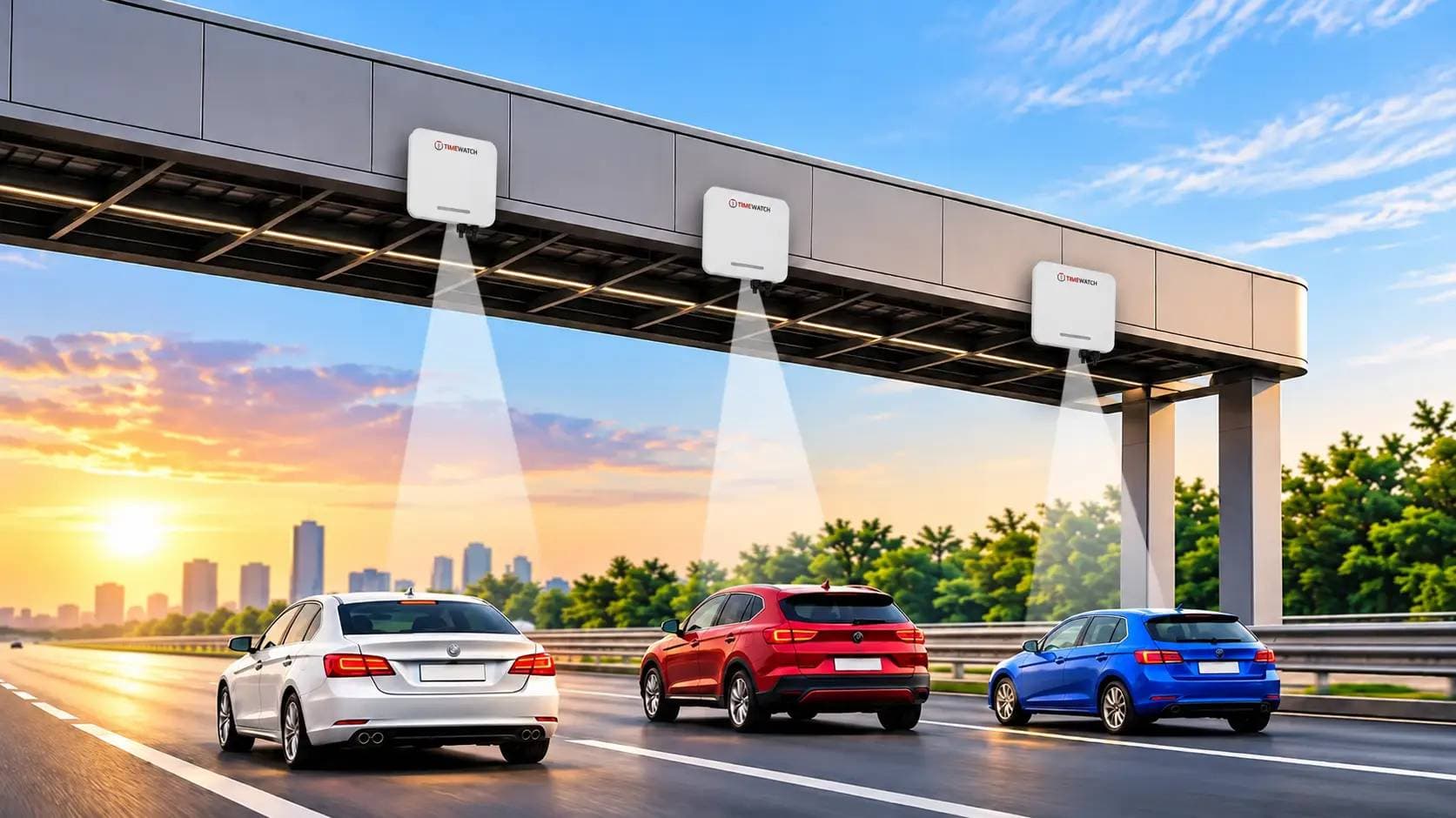
A toll barrier system works in five stages. Sensors classify the vehicle from its physical characteristics. A reader identifies it from a windscreen tag, a ticket or a plate read. The lane controller determines and validates the applicable charge against that class and the linked account. On a valid transaction it releases the barrier, which opens, allows the vehicle through and closes behind it. The transaction is then logged to the central host for reconciliation.
Strip out the fourth stage and you have free-flow tolling: identify, classify, charge, log, and let the vehicle continue at road speed. The mechanism is otherwise the same. That is the whole architectural choice in one sentence, and the rest of this page unpacks what each stage actually involves and when the barrier earns its place.
Free-Flow Gantries and Barrier-Controlled Lanes
This is the first design decision on any charging scheme, and it is better understood as a question about what happens when a transaction fails than as a question about traffic speed.
Under a free-flow gantry, nothing physically prevents passage. The gantry identifies, classifies and records; enforcement is handled afterwards, from the plate capture, against whoever is responsible for the vehicle. The architecture suits open road where stopping traffic would be the greater harm, and it scales to multiple lanes at speed with no lane-side queueing at all. What it demands in engineering terms is that the system be right first time, there is no arm to hold a vehicle while a problem is resolved, so capture reliability, classification accuracy and the downstream enforcement process carry the entire burden.
A barrier-controlled lane inverts that. The arm holds the vehicle until the transaction completes, so a failed read or an unresolved account is dealt with on the spot rather than afterwards. That is valuable wherever after-the-fact enforcement is weak or impossible, on private land, where there is no public enforcement route; at a boundary where the point is to control who enters rather than to charge them; and anywhere the operator needs a positive count of what is inside rather than a record of what went past.
| Aspect | Free-flow gantry | Barrier-controlled lane |
|---|---|---|
| Vehicle behaviour | Passes at road speed without slowing | Slows or stops at the arm until released |
| Identification | Tag read at the gantry, with plate capture in parallel | Tag, ticket, card or plate read at the lane |
| Failed transaction | Resolved afterwards through the enforcement process | Resolved at the lane, which blocks it until cleared |
| Throughput ceiling | Set by the road, not by the equipment | Set by the slowest transaction in the queue |
| Physical access control | None, passage is recorded, not permitted | Yes, nothing passes without a release |
| Typically suited to | Open road corridors, bridge and tunnel approaches at speed, urban charging cordons | Car parks, private estates, gated communities, restricted-access roads, controlled site boundaries |
| Equipment exposure | Elevated gantry structure, long cable runs, roadside cabinets | Lane-side housing, road-embedded loops, barrier mechanism |
Many real schemes are hybrids. A site may run free-flow on its through route and barrier-controlled lanes on its service entrances, or operate free-flow identification for registered users with a barrier-controlled fallback lane for everyone else. The question to settle at design stage is not which is better in the abstract but where, on this specific site, an unresolved vehicle is physically allowed to go.
The Barrier-Controlled Lane Sequence Step by Step
| Step | What happens | How it works |
|---|---|---|
| 1 | Vehicle enters the lane approach | An entry loop or presence sensor registers arrival and opens a new lane transaction. |
| 2 | Vehicle is classified | Automatic vehicle classification sets the applicable class from axle counters in the road, laser or light-curtain profilers at the lane side, and loop signature analysis. The method varies by installation; many combine two rather than rely on one. |
| 3 | Vehicle is identified | The gantry-mounted overhead reader interrogates the windscreen tag on the approach. Lanes serving mixed or visitor traffic may use a ticket, a card or an operator entry instead. |
| 4 | Charge is determined | The lane controller applies the tariff rule for the determined class, including any time-of-day or return-journey rule held in the scheme configuration. |
| 5 | Transaction is validated | The tag identifier is checked against account status: recognised, active, not suspended, and able to settle. |
| 6 | Barrier opens | The controller releases the barrier and updates the lane traffic light and status display so the driver knows the transaction succeeded. |
| 7 | Vehicle passes | An exit loop and a photocell confirm the vehicle has moved clear of the barrier zone. |
| 8 | Barrier closes | The arm lowers once the lane is confirmed clear, timed so a following vehicle cannot tailgate through on the same transaction. |
| 9 | Transaction is logged | Class, tag identifier, amount applied, timestamp, lane, plate read and images go to the lane server and onward to the central host. |
Where the sequence fails (no tag read, an account that cannot settle, a suspended tag, a disputed classification) the lane falls to an exception path. How well that path is designed is what separates a site that flows from one that queues, and it is almost entirely a layout and procedure question rather than an equipment question.
Under a free-flow gantry, steps 6, 7 and 8 simply do not exist. Steps 1 to 5 and step 9 run identically, which is why the same equipment families appear in both architectures and why a supplier's gantry and classification hardware is usually common to the two.
Main Components of a Charging Lane
| Component | Function |
|---|---|
| Overhead gantry structure | Spans the carriageway carrying readers, antennas, cameras and illuminators above the traffic. In the UAE the structural and corrosion specification of the gantry itself is a significant item, not an afterthought. |
| UHF RFID reader and antennas | Interrogates the windscreen tag while the vehicle is still approaching, so identification completes before the decision point. |
| Classification sensors | Axle counters set into the road, laser or infrared profilers at the lane side, and loop signature electronics. |
| Plate capture camera and IR illuminator | Reads the plate of every vehicle passing, for enforcement and reconciliation, in daylight and darkness. |
| Lane controller | Sequences the transaction, applies the tariff rule, drives the barrier where one is fitted, and communicates with the central host. |
| Boom barrier | The physical release mechanism in a barrier-controlled lane, generally a high-duty unit given the cycle counts involved. |
| Traffic light and lane status display | Tells the driver whether the lane is open and whether the transaction completed. |
| Operator terminal | Attended position where exceptions, manual class override and assisted transactions are handled. |
| Overhead lane signage | Shows lane mode far enough back that drivers choose before committing to a lane. |
| Central host / site server | Aggregates lane transactions, holds tag status data, and produces audit and reconciliation output. |
| Roadside cabinet, UPS and power conditioning | Houses and protects the lane electronics and keeps the lane live through supply interruptions. Losing power mid-transaction creates a reconciliation problem rather than just an outage. |
The gantry and the identification reader
The reader sits above the lane because a windscreen tag faces upward and forward. The read zone has to cover the approach so identification completes before the decision point, yet stay tight enough not to pick up a tag in an adjacent lane. Cross-lane reads are a genuine failure mode wherever lanes are closely spaced, and they are managed through antenna polarisation, power setting, physical shielding and aiming. The workable arrangement depends on the reader model and the geometry, and it is established by site testing rather than from a datasheet.
Gantry height and reach also set the maintenance regime. A reader on a high gantry over a live carriageway cannot be reached without a traffic management arrangement, so anything that needs periodic attention (illuminator, camera window, antenna alignment) should be positioned and specified with that access in mind from the first drawing.
Automatic vehicle classification
Classification exists because what is charged depends on what the vehicle physically is, not on what its owner declared. Axle counters detect each axle crossing and can distinguish a lifted axle from a loaded one. Profilers measure height and silhouette. Loop signature systems analyse the shape of the inductance change as the vehicle crosses, which carries usable information about length and undercarriage.
Which combination is used depends on the traffic mix and the accuracy the scheme is held to. A lane seeing articulated vehicles at a logistics gate has a very different classification problem from a car park entry where almost everything is a passenger vehicle, and specifying the heavier sensor set where it is not needed adds failure points without adding accuracy.
Plate capture as the enforcement layer
This is the point most often misunderstood, and it is worth stating directly: in a tag-based scheme, plate recognition is not how the vehicle is identified for charging. The tag is. Plate capture runs in parallel, recording every vehicle whether or not the tag reads, and it serves enforcement and reconciliation, recovering a charge after a failed read, evidencing an account that could not settle, and identifying vehicles that pass with no valid transaction at all.
Treating plate recognition as the primary identification method is a specification error, because plate reading is affected by plate condition, obscuring, approach angle, glare and format variation in ways a tag read is not. In this country that last factor is concrete: plates are issued by individual emirates and vary in layout and character presentation, and lanes near the borders also see visiting plates from outside the country, so the recognition engine must handle a mixed population rather than one national pattern.
Lane controller, barrier and driver signalling
The controller is the only component that sees the whole transaction, which is why it, and not the barrier, holds the timing and safety logic. The barrier itself behaves like any other boom barrier: a safety loop under the arm, a photocell across the lane, and obstruction detection at the drive that reverses the arm on unexpected resistance. What differs from a campus gate is the duty rating and the tightness of the timing window.
Driver signalling deserves more attention than it usually gets. A lane that has decided to refuse a transaction but has not told the driver clearly produces the same queue as a lane that failed to read, because the driver waits for an arm that is not going to lift. Status display legibility in strong daylight is an engineering requirement here, not a finishing detail.
How Windscreen-Tag Identification Works
The tag used in road charging and in gate access is normally a passive UHF RFID device. Passive means it carries no battery: the reader radiates RF energy, the tag harvests enough of it to power its chip, and it backscatters its identifier. Read at several metres, so the vehicle is identified while still approaching and never has to stop for the identification step itself. The specific frequency band, air interface and tag specification are set by the scheme and by the radio regulations of the jurisdiction concerned, and should be confirmed for any particular deployment rather than assumed.
Tag placement matters more than operators expect, and it is the first thing to check when a lane's read rate drops. A tag sitting behind metallised or heat-reflective windscreen glazing reads unreliably or not at all, because the coating attenuates RF energy in both directions. Glazing of that type is widespread in this climate for obvious reasons, which makes agreed mounting positions, manufacturer-designated tag windows in the glass, or hard tags rather than glass-mounted labels, a routine part of a UAE deployment rather than an exception.
The same applies to a tag placed on the wrong part of the glass, over a demister element, or peeled off and reattached after being moved between vehicles. A lane with a declining read rate should be checked for fitment across a sample of vehicles before the reader is suspected, because reader faults are comparatively rare and fitment problems are comparatively common.
There is one useful local advantage. Drivers here are already thoroughly familiar with windscreen-tag vehicle identification from road charging, so when the same idea is applied at a car park entry, a community gate or a logistics plot boundary, there is very little to explain. Tenant and driver adoption is noticeably easier than in markets where the concept arrives cold.
Where Barrier-Controlled Lanes Still Apply in the UAE
If open-road charging increasingly runs without an arm, it is fair to ask where a barrier still belongs. The answer is consistent: wherever the operator needs the ability to physically refuse passage, or needs a positive count of what is inside a boundary, rather than a record of what went past.
- Car parks and multi-storey structures: a parking operation charges by duration, which requires a matched entry and exit for every vehicle. A missed entry is not a small inaccuracy; it breaks the calculation entirely. The barrier is what forces the pairing, and it is also what enforces bay allocation when a structure is at capacity.
- Bridge, causeway and tunnel approaches with mixed users: where a crossing serves both registered and unregistered traffic, or where an operator needs to hold a vehicle that cannot complete a transaction rather than pursue it afterwards, a controlled lane remains the workable arrangement. Where every user is registered and enforcement is reliable, free-flow is the better fit.
- Restricted-access roads and service routes: internal estate roads, port and terminal access roads, airport airside support routes and utility corridors are about permission rather than charging. The decision is binary and the answer must be enforced at the point, so an arm is required.
- Gated communities and villa compounds: residents on windscreen tags, visitors handled at a guard post. Here the barrier is the whole point: the community wants vehicles it has not authorised to be stopped, not logged.
- Free-zone plots, logistics yards and industrial boundaries: gate-pass and weighbridge logic means the arm must stay down until several conditions are satisfied at once, which free-flow architecture cannot express.
- Private land generally: the practical driver is that after-the-fact enforcement against a vehicle that has already left private property is far weaker than at a public-road scheme. Where recovery after the event is uncertain, control at the point is the sound engineering answer.
A useful rule of thumb: free-flow suits charging for passage, barrier control suits granting entry. Schemes that have to do both usually end up with free-flow on the corridor and barrier-controlled lanes at the boundaries that hang off it.
How Toll Barrier Timing Is Set
Barrier timing in a charging lane is a tighter trade-off than almost anywhere else boom barriers are used. The arm must drop quickly enough that a closely following vehicle cannot tailgate through on a single transaction, because that produces a discrepancy between the vehicle count and the transaction record that somebody has to reconcile later, but not so quickly that it strikes the vehicle that has just completed its transaction.
The resolution is the layered protection used on any boom barrier: a safety loop beneath the arm that inhibits closure while a vehicle is present, a photocell across the lane that stops and reverses the arm on obstruction, and obstruction detection at the drive. Closing is triggered by the exit loop de-energising rather than by a fixed timer, so the arm follows the actual vehicle rather than a guess at how long it will take.
Exact opening and closing times are a specification of the barrier model and its duty rating, and they should be confirmed against the datasheet for the equipment being specified. In this climate they should also be confirmed at the ambient temperature the lane will actually see, not at the reference condition the figure was measured at.
What Actually Limits Lane Throughput
Throughput is limited by read reliability at the gantry, not by barrier speed, which is where most lane troubleshooting goes wrong. A lane reading reliably at 95 per cent does not spend 95 per cent of its time running smoothly; it spends its time handling the other 5 per cent, because each failed read turns a three-second pass into a manual intervention with a stopped vehicle and a queue behind it. Making the barrier faster changes very little. Raising the read rate changes everything.
The second common blocker is not a read failure at all. The vehicle is identified perfectly (reader has the tag, account is known, class is settled) and the transaction still cannot complete because the account cannot settle. The system has done its job correctly. The question is where that vehicle physically goes next and how fast it clears the through lane, and that is a layout and procedure decision taken long before any equipment is chosen.
The third is reconciliation between classification and registration. Classification reports what the vehicle physically is; the tag reports what it was registered as. A tag registered against one class and fitted to a vehicle of another produces a mismatch the lane has to resolve, and it is a routine source of dispute at the lane and in later audit. Sites handle it with defined override procedures and by retaining the classification evidence and images with the transaction record.
How Coastal Salt, Humidity and Heat Affect Roadside Equipment
Charging lane equipment is outdoor electronics with a long service expectation, mounted where it cannot easily be reached, in one of the more demanding environments it will encounter anywhere. Most UAE development sits close to the Gulf coast, which makes salt-bearing humid air a near-universal design condition rather than a special case reserved for seafront sites. The following four effects are distinct, and specifying for one while ignoring the others is how installations end up being replaced early.
Gantry steelwork, mounting and fixings
The gantry is the most exposed and least accessible structure in the system, which makes its corrosion specification disproportionately important. Hot-dip galvanising with an appropriate coating system over it, stainless fixings of a suitable grade rather than plated carbon steel, and attention to the base plate detail where wash-down water and condensation collect are the practical items. Dissimilar-metal contact at mounting brackets (an aluminium enclosure bolted to galvanised steel with the wrong fastener) sets up galvanic corrosion that will not be visible until the bracket is already compromised.
Because access requires traffic management, the sensible design posture is to over-specify corrosion protection on anything mounted above the carriageway rather than plan to maintain it frequently. The inspection interval that is realistic for a gantry is much longer than the one that is realistic for a lane-side cabinet, and the specification should reflect that difference.
Cabinet sealing, terminations and condensation
The most common corrosion-related fault in roadside electronics is not a rusted enclosure but a degraded electrical termination. Humid, salt-bearing air entering a cabinet through an unsealed gland or a poorly seated door gasket reaches terminal blocks, connectors and board edge contacts, and produces intermittent faults long before anything looks visibly failed. Intermittent faults are the hardest kind to resolve, because they are diagnosed by replacing components that were not at fault.
Gland selection, intact gaskets and a cabinet that is genuinely sealed where it claims to be are worth more in practice than a higher headline ingress rating on a housing whose door seal has been left loose. Condensation needs its own thought: cabinets that cool below the dew point on humid nights collect internal moisture, and breather arrangements or cabinet heating are both used depending on the enclosure and the site. Any below-ground joint in a loop feeder must be made in a properly sealed, water-excluding manner, because a joint that admits moisture here produces erratic detection that is then misdiagnosed as a detector card fault.
Optical equipment, dust and shamal events
Plate capture quality degrades gradually as a fine film builds on the camera window and the illuminator lens, and it degrades below usable levels well before anyone notices the film visually. The same applies to photocell lenses at a barrier, where a dust film produces nuisance obstruction alarms that tempt site teams into bypassing the device.
Dust loading is not uniform through the year. The fine dust that settles after a shamal wind event is a recognised maintenance trigger across the region: after a significant blow, camera windows, illuminators, photocell lenses and cabinet ventilation filters across a site all need attention at once, whether or not a scheduled service is due. Teams that fold a post-event inspection into their routine see noticeably fewer capture failures in the following weeks than teams working to a fixed calendar alone. Strong direct sun is the other optical factor, producing glare and heavy shadow at particular hours on east- and west-facing approaches, which is addressed at design stage through camera angle, shading and illuminator specification rather than afterwards.
Barrier duty rating at high ambient temperature
In a barrier-controlled lane the arm cycles once per vehicle, which puts the drive into a far higher duty band than a campus gate ever reaches. A motor's duty rating is a thermal statement: it describes how much heat the motor can generate and shed before reaching its limit. When the surrounding air is already above 45°C, the motor sheds heat more slowly, so the same mechanical work produces a higher winding temperature and the usable duty falls.
The practical conclusion is that a barrier chosen on its catalogue cycle rate will struggle on a busy UAE lane in summer. Specification should start from the lane's peak hourly traffic rather than its daily average, apply a derating margin for ambient temperature, and then select a drive with headroom above that figure. Shading the housing from direct solar gain, specifying effective filtered ventilation or thermostatic cooling, and avoiding dark housing colours on fully exposed lanes are all supporting measures that are far less disruptive to design in than to retrofit.
The Regulatory Context for Charging and Access Lanes in the UAE
Nothing in this section should be read as a statement of current rules. Requirements differ between emirates, differ again inside free zones, and change over time. They must be confirmed per project with the relevant authority before equipment is selected, not after.
SIRA and the Dubai security regulatory framework
Security systems in Dubai, and the companies that supply and install them, operate within the regulatory framework of SIRA, the Security Industry Regulatory Agency. Where a controlled lane forms part of a site's security provision (and a gate that decides who enters a plot or a community generally does) equipment selection and installer engagement are a regulated matter rather than purely a commercial choice. The fact that the device is a mechanical arm in a driveway does not place it outside that framework.
The planning implication is straightforward. Establish early, with the relevant authority, what applies to your site and system type: which elements fall within scope, what is expected of the company carrying out the work, and what documentation the project will need to produce. No supplier, TimeWatch included, should be understood as conferring regulatory status on a project, and no product should be described as approved or certified unless the issuing authority has said so in writing for that specific case.
Civil defence and lane behaviour on fire alarm
The life-safety aspects of an installation fall under civil defence authority, Dubai Civil Defence within that emirate, and the equivalent authorities elsewhere in the country. For a barrier-controlled lane the central question is behaviour on fire alarm: what the arm does when the site's fire alarm system activates, how that signal reaches the lane controller, whether the interface is monitored, and whether the arm opens and holds so vehicles can clear and emergency appliances can enter.
Because this is a life-safety function it should be designed as an interface between two systems rather than added at the end as a pair of wires. The fire alarm contractor and the lane installer need to agree the signal type, the fail-safe direction, the cabling route and the test method, and that agreement needs to be documented for the authority. The interface should then be tested as part of the site's scheduled fire drills rather than only at handover.
Abu Dhabi, the northern emirates and free zones
Abu Dhabi operates its own framework through its own bodies, and a package prepared for a Dubai project does not transfer unchanged to a site in Mussafah or on the islands. The northern emirates (Sharjah, Ajman, Umm Al Quwain, Ras Al Khaimah and Fujairah) each have their own municipal and civil defence arrangements, and an operator working across several emirates should expect to confirm requirements separately for each.
Free zones add a further layer. Zones such as Jebel Ali and Dubai South commonly apply their own site rules, permitting processes and contractor registration requirements on top of emirate-level regulation, and those are the rules that actually govern what happens at the plot boundary. For a logistics operator installing controlled lanes on a free-zone plot, the sequence that works is: establish the zone authority's requirements first, then the emirate-level requirements, then specify the equipment. Working in the other direction tends to produce rework.
Where Charging and Paid-Access Lanes Are Used in the UAE
The same architecture turns up wherever passage is charged, counted or permitted, and the UAE has an unusually dense spread of such sites for its size.
- Multi-storey and surface car parks: malls, mixed-use developments, hospital campuses and office towers, where duration-based charging requires every entry to be paired with an exit. This is the single largest category of barrier-controlled lanes in the country.
- Airport estates: forecourt and long-stay parking, staff and service vehicle entries, cargo village gates and airside support roads at Dubai International, Al Maktoum International and Zayed International, where the barrier handles traffic management and any protective requirement is met separately.
- Ports, free zones and logistics gates: plot entrances, truck lanes and container yard boundaries around Jebel Ali Port and JAFZA, the Dubai South area, and Khalifa Port and KIZAD, frequently integrated with weighbridge and gate-pass logic and running some of the highest duty cycles in the country.
- Gated communities and villa compounds: residents on windscreen tags, visitors through a guard post, with the access record serving community management as much as security.
- Restricted estate and service roads: internal roads on large developments, utility and industrial corridors, and campus perimeters at universities and government facilities across Dubai, Abu Dhabi, Sharjah and the northern emirates.
- Hotel and resort properties: guest arrival courts, valet lanes and service yards, each with a different user population and a different tolerance for delay at the point of entry.
- Industrial estates and workshop districts: the warehouse areas such as Al Quoz and Mussafah, where goods vehicle movement, contractor control and yard counting all run through a small number of gates.
- Bridge, causeway and crossing approaches: where charging or access control is applied at a crossing serving a mix of registered and visiting traffic.
TimeWatch supplies boom barriers, long-range UHF RFID readers and plate recognition equipment used in lanes of this kind across the United Arab Emirates, from Dubai and Abu Dhabi through Sharjah and Ajman to Ras Al Khaimah, Fujairah and Umm Al Quwain.
Integration With Other Systems
- Central host and reconciliation: lane transactions flow upward for clearing, audit and reporting, and the integrity of that flow is what makes the system auditable at all.
- Plate capture and video management: plate reads and images bound to the transaction, so any passage can be reviewed from its log entry rather than by scrubbing recordings.
- Parking management platforms: duration-based charging on the same lane hardware, with occupancy counting and bay allocation by tenant.
- Weighbridges and gate-pass systems: common at free-zone and port-adjacent sites, where the arm releases only once the weighment and the gate pass are both complete and recorded.
- Access control platforms: the same credential database governing doors, turnstiles and vehicle lanes, so a single revocation closes every route at once.
- Visitor management: a pre-approved visitor's vehicle recognised at the lane, with arrival notified to the host.
- Traffic management and variable message signs: lane status, mode and queue data fed to approach signage far enough back for drivers to act on it.
- Fire alarm systems: open-and-hold on alarm, designed and documented as described in the regulatory section above.
Installation and Maintenance Considerations for UAE Lanes
Installation
- Gantry position and antenna aiming: fix the read zone at design stage and verify by site test that adjacent lanes do not cross-read. This cannot be settled from a datasheet.
- Access for maintenance: decide at design stage how a camera window, illuminator or antenna on the gantry will be reached, and what traffic management that requires. Equipment that cannot be maintained will not be maintained.
- Classification sensor geometry: accuracy depends on the vehicle crossing counters, profilers and loops in a known order, so lane channelisation with kerbs or islands improves both read rate and classification accuracy at once.
- Camera mounting and shading: height, angle, illumination and sun shading are design decisions driven by the approach orientation, not adjustments made after commissioning.
- Loop cutting workmanship and sealing: slot depth, turn count and a sealant rated for the surface temperatures the site actually reaches. Asphalt softens considerably under peak summer surface temperatures, and heavy vehicles over softened asphalt deform the slot, so heavy-truck lanes are usually better served by a concrete apron than by asphalt.
- Corrosion specification agreed at design stage: galvanising, coating system, fixing grade and gland selection set against the site's exposure, rather than chosen on site by whoever is installing.
- Earthing, surge protection and UPS sizing: exposed electronics on long cable runs need both, and the UPS must be sized to ride through an interruption without losing a live transaction.
- Barrier duty rating: specified against projected peak cycle count with an ambient derating margin applied, which typically lands well above what a commercial gate would need.
- Driver signalling legibility: lane status displays and signage specified for readability in strong direct daylight, and positioned far enough upstream that drivers can still change lane.
- Authority coordination: permitting, approvals and documentation for the emirate and, where applicable, the free zone, confirmed before equipment is ordered.
Maintenance
- Track lane read rate as a managed metric. A gradual decline is the earliest available warning of a reader, alignment or tag-fitment problem, and it appears in the data long before it appears as a queue.
- Verify classification output against a sampled manual count at defined intervals, and keep the sample records.
- Clean camera windows, illuminator lenses and photocell optics on a schedule set by conditions, and add an unscheduled inspection after any significant dust or shamal event.
- Open roadside cabinets and inspect terminations, glands and gaskets for corrosion, discoloration or moisture ingress. On a coastal site this is the single most useful preventive check available.
- Confirm cabinet ventilation filters are clear, particularly before the summer peak when the thermal margin is smallest.
- Test loop continuity and insulation, especially after any resurfacing or trenching work on the approach.
- Inspect the barrier arm for impact damage, check balance spring tension and reset it after any arm change, and confirm photocell alignment.
- Confirm the safety loop still inhibits closing, and test the manual release before it is needed rather than during an outage.
- Test the fire alarm interface as part of scheduled fire drills and record the result.
- Inspect gantry steelwork, brackets and fixings for corrosion at the longest interval the access arrangement allows, and treat any finding as a specification lesson for the next lane.
Benefits and Limitations
Benefits
- Non-stop passage when the tag reads, which removes stop-start traffic at the point of charging and keeps approach queues short.
- A complete audit trail, every passage timestamped, classified and image-backed, which is what makes reconciliation and dispute handling possible at all.
- Classification applied consistently by sensor rather than by operator judgement, with the evidence retained alongside the transaction.
- Drivers are identified without lowering a window, a genuine comfort and throughput advantage for several months of the year here.
- The same identification stack serves charging, access control and counting, so a site can run one technology across several different jobs.
- Where free-flow is appropriate, the throughput ceiling moves from the equipment to the road itself.
Limitations and considerations
- A barrier is not a security device. A boom arm will not stop a vehicle driven through it. Lane-running is handled after the fact, which is exactly what the plate capture layer exists for, and where physical protection is the requirement, crash-rated equipment is the correct answer.
- Read reliability governs throughput, and the largest single influence on it is tag fitment in the vehicle, which is outside the operator's direct control.
- Account settlement failures sit outside the system entirely. They have to be absorbed by lane layout and exception procedure, not solved with equipment.
- Plate recognition accuracy varies with plate condition, glare, dust on the camera window, approach angle and the mixed population of emirate plate formats a UAE lane will see. It needs a defined fallback path.
- Road-embedded components are disturbed by road works, by heavy vehicle loading on softened asphalt, and by water ingress at joints, and repairing them means cutting the surface again.
- Corrosion is cumulative and quiet. The damage done by humid, salt-bearing air shows up as intermittent electrical faults long before anything looks obviously wrong, so termination inspection has to be deliberate rather than visual from outside.
- Regulatory requirements are not uniform. What satisfies one emirate or free zone may not transfer to another, and requirements change, so each project needs its own confirmation.
- Performance varies by equipment and geometry. Read range, classification accuracy, barrier timing and capture rates are specifications of particular models in a particular layout, and should be confirmed against datasheets and site testing rather than assumed.
Toll Lane vs Standard Boom Barrier Gate
| Charging or toll lane | Standard boom barrier gate | |
|---|---|---|
| Primary purpose | Charge determination, transaction validation and auditable release | Access authorisation and passage recording |
| Identification | Tag read at range with plate capture as the enforcement backstop | RFID, plate recognition, card, ticket or manual button |
| Classification | Required, what is applied depends on vehicle class | Usually not required |
| Duty cycle | Very high, and specified with an ambient derating margin | Low to medium at most sites |
| Consequence of an error | A reconciliation discrepancy that must be investigated | An access event to be reviewed |
| Can it run without an arm? | Yes, as a free-flow gantry, where enforcement is after the event | No, the arm is the function |
The mechanism at the arm is the same in both. What differs is everything upstream of it. A barrier specified for a campus entrance will not survive a charging lane's cycle count in this climate, and a charging lane's decision chain would be redundant at a campus entrance. The useful question when specifying is not which type of equipment is wanted but what the site needs to be able to prove afterwards.
Frequently Asked Questions
How does a toll barrier system work?
A toll barrier system classifies the approaching vehicle, identifies it by reading its windscreen tag or by issuing a ticket, determines the charge for that class and validates it against the linked account, then releases the boom barrier. Once the vehicle has passed and the lane is confirmed clear, the barrier closes and the transaction is logged to the central host for reconciliation.
What is the difference between free-flow tolling and a barrier-controlled lane?
A free-flow gantry identifies, classifies and records a vehicle at road speed with nothing physically preventing passage, so a failed transaction is resolved afterwards through enforcement. A barrier-controlled lane holds the vehicle at the arm until the transaction completes, so a failure is resolved on the spot. Free-flow suits charging for passage on open road; barrier control suits granting entry where the operator must be able to refuse it.
How does a gantry identify a vehicle without it stopping?
The vehicle carries a passive UHF RFID windscreen tag with no battery. The gantry reader radiates RF energy, the tag harvests enough of it to power its chip, and it backscatters its identifier to the reader. Because the read happens over several metres while the vehicle is still approaching, identification completes before the decision point and the vehicle never stops for that step.
What is automatic vehicle classification at a toll lane?
Automatic vehicle classification determines a vehicle's class from its physical characteristics rather than from what it declares. Installations use axle counters set into the road, laser or light-curtain profilers that measure height and silhouette, and loop signature analysis of the inductance change as the vehicle crosses. The combination used depends on the traffic mix, and many sites use two methods rather than relying on one.
Is the number plate camera used to charge the toll?
No. In a tag-based scheme the tag read is the primary identification method, and plate capture runs alongside it as the enforcement and reconciliation layer. It records every vehicle whether or not the tag reads, and its output is used where a read failed, where an account could not settle, and where a vehicle passed with no valid transaction at all. Treating plate recognition as the primary method is a specification error.
Where are barrier-controlled lanes still used in the UAE?
Wherever an operator needs to physically refuse passage or needs a positive count of what is inside a boundary. That means car parks and multi-storey structures, where duration charging requires every entry to pair with an exit; gated communities and villa compounds; restricted-access estate, port and service roads; free-zone plots and logistics yards with gate-pass or weighbridge logic; and private land generally, where recovery after a vehicle has left is far weaker than at a public-road scheme.
How do coastal salt air and humidity affect toll and gantry equipment in the UAE?
Most UAE development sits close to the Gulf coast, so salt-bearing humid air is a routine design condition rather than a special case. It corrodes gantry steelwork, brackets and fixings, and it degrades electrical terminations inside roadside cabinets, which is the more damaging effect because it produces intermittent faults long before anything looks visibly failed. Hot-dip galvanising, stainless fixings of a suitable grade, correct gland selection and genuinely intact door gaskets are the practical responses.
Does dust after a shamal affect number plate reading?
Yes, and usually before anyone notices visually. A fine film on the camera window and the infrared illuminator lens degrades capture quality gradually, and the same film on photocell optics at a barrier produces nuisance obstruction alarms. A post-event inspection of camera windows, illuminators, photocell lenses and cabinet ventilation filters, run outside the normal schedule after any significant blow, prevents most of the resulting faults.
How fast does a toll barrier close?
Fast enough to prevent a following vehicle tailgating through on one transaction, but not so fast that it strikes the vehicle that has just completed its own. Closing is normally triggered by the exit loop de-energising rather than by a fixed timer, with a safety loop and a photocell preventing closure on a vehicle. The exact timing is a specification of the barrier model and should be confirmed at the ambient temperature the lane will actually operate at.
Why do lanes queue even when the barrier is fast?
Because throughput is governed by read reliability at the gantry, not by barrier speed. A lane reading reliably at 95 per cent spends its time handling the other 5 per cent, and each failure turns a non-stop pass into a stopped vehicle and a manual intervention with a queue behind it. Raising the read rate reduces queueing far more than making the arm move faster, and the most common root cause is tag fitment in the vehicle rather than the reader.
Do charging and controlled-access lanes in Dubai fall under SIRA regulation?
Security systems in Dubai, and the companies that supply and install them, operate within the regulatory framework of the Security Industry Regulatory Agency, so where a controlled lane forms part of a site's security provision, equipment selection and installer engagement are a regulated matter rather than purely a commercial decision. What applies to a particular installation depends on the site and the system type. Requirements also differ between the emirates and change over time, so a project team should confirm the current position directly with the relevant authority.
