
How Does a UHF RFID Reader System Work?
What Is a UHF RFID Reader System?
If you live or work in the UAE, you already understand the user experience of this technology, because a sticker on a windscreen that identifies a vehicle while it is still moving is a familiar idea here through road tolling. That familiarity is worth more than it sounds. When a tower or a community moves from guard-operated entry to tag-based entry, there is very little to explain to residents and tenants, the object is recognisable, the behaviour is expected, and support calls asking what the sticker is and why it must stay on the glass are comparatively rare. Adoption friction, which can be the hardest part of an access project elsewhere, is unusually low in this market.
What the technology actually delivers is identification without stopping, aligning or presenting anything. Everything difficult about deploying it follows from the same property: energy that reaches several metres does not stop where the lane marking does.
How Does a UHF RFID Reader System Work?
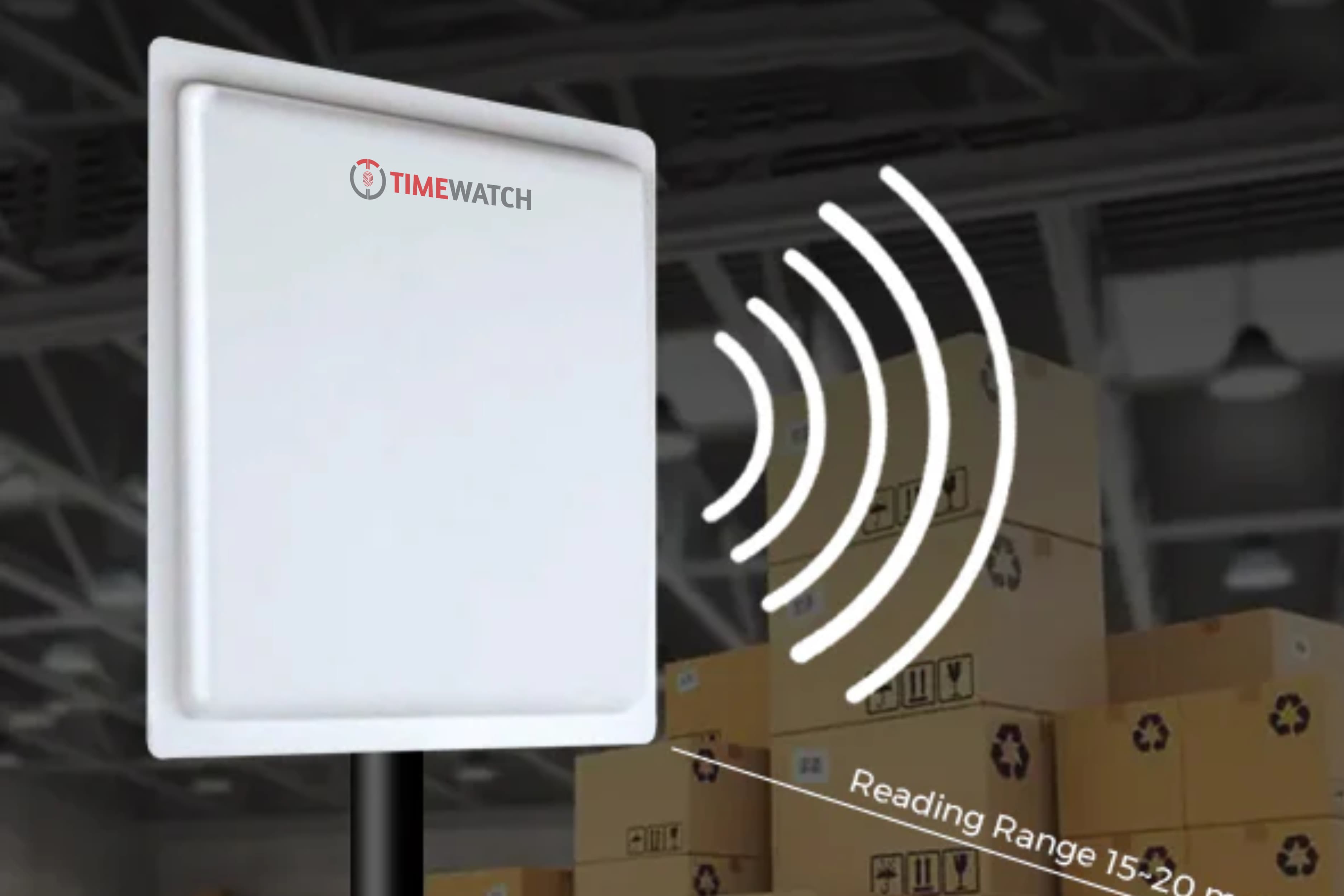
A UHF RFID reader system works in four stages. The reader transmits RF energy through coaxial cable to one or more antennas, which radiate it into a defined area. A passive tag entering that area harvests enough energy to wake its chip. The chip replies by backscatter, modulating how much energy it reflects so the reflection carries its identifier. The reader decodes the returned signal and passes the identifier to a controller or host application.
Transmit, harvest, backscatter, decode. Everything below is detail beneath those four stages, including the enclosure engineering that decides whether the read point on a seafront ramp still performs the same way in its fourth year.
The Working Principle: Energy Harvesting and Backscatter
How a passive tag powers itself
A passive tag is an antenna printed or etched on a substrate with a small chip bonded to it, no battery, no oscillator, no stored energy. In the reader's field an alternating voltage appears across the antenna terminals. A rectifier, in practice a multi-stage charge pump, converts it to a small DC supply that accumulates on a capacitor until the chip's logic comes out of reset. Electrically the tag exists only while it sits in a field strong enough to power it, which is why read range is a property of the installation rather than of the tag alone.
What backscatter actually means
Generating a carrier would need far more energy than the tag has harvested, so it cannot transmit in the ordinary sense. Instead it switches its own antenna between two impedance states: in one it reflects more of the incoming energy, in the other less. Switching in a timed pattern imposes its data onto the energy it is already bouncing back. The reader transmits and listens at the same time, sees its own carrier returning with a faint pattern superimposed, and decodes the bits. The returning signal is very weak relative to the transmitted one, which is why every decibel lost between reader and antenna matters twice over.
Why UHF reaches metres when HF reaches centimetres
LF and HF systems work by inductive coupling: the reader coil produces a magnetic field and the tag coil sits inside it like a transformer secondary. That coupling falls away sharply with distance, which is why 125 kHz and 13.56 MHz readers work at centimetres and need the card presented. UHF works by radiative coupling. The wavelength in the UHF RFID region is roughly a third of a metre, short enough for a compact antenna to radiate efficiently, and the tag is illuminated by a propagating wave rather than held in a magnetic field. The same property that gives the range gives the problems: radiated energy reflects off metal, is absorbed by water, and travels past the point where you wanted it to stop.
Which UHF Frequency Band Applies in the UAE
This belongs near the front of any UAE specification, because it governs procurement rather than configuration.
UHF RFID does not use one worldwide frequency. National administrations allocate different sub-bands and different radiated power limits for RFID, and a reader is manufactured and type-approved for a specific band. A unit built for one region's allocation is not retuned on site, its radio front end, filtering and approval documentation all belong to that band. Tags are more tolerant, since a modern EPC Gen2 inlay is usually designed to respond across a wide span, but their performance is not flat across it, so a tag optimised for one regional band will not necessarily give the same read distance in another.
For a project here, the position must be established with the authority rather than inferred:
- Confirm the UHF RFID band and the permitted radiated power that apply in this market with the national telecommunications regulator, and obtain that confirmation in writing before readers, antennas and tags are selected.
- Confirm the type approval, registration and import arrangements for the radio equipment, and establish who in the supply chain carries that obligation, on a free-zone project this question has more than one answer.
- Specify the reader variant by band in the purchase documentation, not by model family alone. Manufacturers publish regional variants of the same reader, and ordering the wrong variant is an easy mistake to make on paper and a slow one to unwind at site.
- Ask the supplier to state tag performance in the band that applies here, rather than accepting a generic range figure measured elsewhere.
Nothing on this page states what the current allocation is, and a figure published for another country should never be assumed to apply. Spectrum allocations are national, they change over time, and the regulator is the only reliable source.
LF, HF and UHF RFID Compared
| Aspect | LF, 125 kHz | HF, 13.56 MHz | UHF |
|---|---|---|---|
| Coupling method | Inductive, near field | Inductive, near field | Radiative, far field |
| Typical read range | A few centimetres | Around 10 cm in access use | Metres, depending on antenna, tag and placement |
| Metal and liquid tolerance | Good | Moderate; some detuning near metal | Poor without design allowance, metal reflects, water absorbs |
| Multi-tag reading | Generally one at a time | Possible but limited | Designed for it; anti-collision resolves large populations |
| Frequency allocation | Broadly consistent internationally | Broadly consistent internationally | National sub-band and power limit, confirm with the regulator |
| Typical use | Animal tagging, proximity cards, immobilisers | Access and smart cards, payment, NFC | Vehicle access, parking, container and yard tracking, inventory |
Frequency choice is not a question of one band outperforming another. It is a question of whether the application needs a deliberate presentation gesture at close range, or identification of something moving past at a distance.
Main Components of a UHF RFID Reader System
| Component | Function |
|---|---|
| Reader (fixed) | Generates the RF carrier, drives several antenna ports, decodes backscatter and outputs tag data over the network. On an outdoor UAE installation its enclosure sealing matters as much as its radio performance. |
| Reader (integrated) | Reader and antenna in one housing, simpler to mount and cable, less flexible in aiming and port count, and with the electronics unavoidably exposed at the read point. |
| Antennas | Radiate the field and capture the returning backscatter. Gain and polarisation define the read zone; the radome keeps dust, spray and water off the face. |
| Coaxial cable and connectors | Carry RF between reader and antenna. Every metre loses signal in both directions, and in this climate every outdoor connector is a corrosion site unless it is sealed properly. |
| Passive tags | Windscreen sticker, hard tag, on-metal tag or label, chosen by mounting surface and by the environment that surface sits in. |
| Middleware / controller | Filters, de-duplicates and time-stamps raw reads, turning a continuous read stream into discrete events. |
| Host software | Access control, parking, community management or yard platform holding the tag-to-identity mapping and the permission rules. |
| Output interface | Relay, Wiegand, RS-485 or network message to a barrier controller, door controller or server. |
| Enclosure, earthing and surge protection | Outdoor housing, gasketing, gland selection, earthing and surge arrestors on long cable runs. On a coastal site this is a functional component rather than a detail. |
How Does a UHF RFID Reader System Work Step by Step?
| Step | What happens | How it works |
|---|---|---|
| 1 | Reader energises the antenna | An RF carrier in the nationally allocated UHF RFID band is delivered through coaxial cable to the antenna port. |
| 2 | Antenna radiates a field | Gain and polarisation shape that energy into a read zone covering the lane, ramp, dock door or shelf. |
| 3 | Tag enters the field | A windscreen tag, hard tag or label on the vehicle, container or item crosses into the illuminated volume. |
| 4 | Tag harvests energy | Induced voltage is rectified to DC by a charge pump and accumulates until the chip powers up. |
| 5 | Reader runs an inventory round | The reader issues a query specifying a number of reply slots; each powered tag picks one at random. |
| 6 | Tag replies by backscatter | In its slot the tag switches antenna impedance in a timed pattern, modulating the reflected energy. |
| 7 | Reader decodes the identifier | The receiver extracts the modulation from its own returning carrier and resolves the identifier. |
| 8 | Tag is singulated and silenced | The reader acknowledges the tag, which stays quiet so the remaining tags can be resolved. |
| 9 | Middleware filters the stream | Repeat reads collapse into one event; weak or out-of-zone reads are discarded on signal strength. |
| 10 | Host application acts | The identifier is matched to a record and an output raises the barrier, releases the door or updates the yard inventory. |
Shaping the Read Zone
A read zone is not a sphere around the antenna. It is a shaped volume, and shaping it deliberately is most of the engineering work in a UHF installation. On a tower ramp with two lanes side by side, or a yard gate with trucks queued nose to tail, the complaint is almost never that tags do not read, it is that the wrong ones do.
Antenna gain and mounting angle
Gain does not create energy, it concentrates it. A higher-gain antenna produces a narrower, longer beam from the same power; a lower-gain one produces a wider, shorter beam. Mounting angle decides where that beam lands. Aimed straight down a lane it reads vehicles far away, including the ones queued behind and the ones in the adjacent lane. Angled downward onto the road a few metres ahead of the barrier, the same antenna reads the vehicle at the stop line and little else. In a basement ramp, where concrete soffits and steel services sit close overhead, the reflected paths are shorter and stronger than in open air and the aiming needs to be tighter still.
Circular and linear polarisation
A linearly polarised antenna concentrates energy in one plane: range is longer when the tag's orientation matches that plane and collapses when it does not. A circularly polarised antenna sweeps the plane continuously, coupling to a tag at any rotation but at roughly half the effective range. The choice follows from whether orientation is predictable. A windscreen tag sits in a known, fixed position on every vehicle, so linear polarisation is reasonable at a community gate or a tower ramp. A container tag, a tagged pallet or a hand-carried asset tag arrives at any angle, and circular is the pragmatic answer in a yard.
Transmit power and coaxial cable loss
Transmit power is set within the limit permitted for the band by the national allocation, but the power reaching the antenna is always less than what leaves the reader, because coaxial cable has loss, and that loss is paid twice, once on the outgoing carrier and again on the very weak returning backscatter. A long run between a reader mounted conveniently in a plant room and an antenna out at a yard gate can lose enough signal to measurably shorten read range. Reader placement is a design decision, not a convenience. Where the electronics cannot sit close to the antenna, the alternatives are lower-loss cable or an integrated reader at the read point, which puts the electronics outdoors and raises the enclosure specification discussed later.
Duplicate Reads and the Job of the Middleware
A tag inside a read zone is not read once. It is read many times per second for as long as it stays there, so one car waiting at a community gate can generate hundreds of reads of the same identifier. Deciding which of those constitute a single event is the job of the middleware, not the reader. Typical rules include a debounce window suppressing repeat reads of the same tag, a received-signal-strength threshold ignoring weak reads from outside the intended zone, a minimum read count before an event is declared, and antenna-port logic inferring direction from which antenna saw the tag first. Without that layer a parking platform logs one vehicle arriving several hundred times, and the occupancy count that a tower or a mall operator relies on stops matching reality.
The Regulatory Context for RFID Access Systems in the UAE
This is the part of RFID specification that differs most from other markets, and it is worth understanding before equipment is chosen rather than after. Nothing in this section should be read as a statement of current rules. Requirements differ between emirates, differ again inside free zones, and change over time. They must be confirmed per project with the relevant authority.
SIRA and the Dubai security regulatory framework
Security systems in Dubai, and the companies that supply and install them, operate within the regulatory framework of SIRA, the Security Industry Regulatory Agency. The practical consequence for a project team is that equipment selection and installer engagement in Dubai are a regulated matter rather than purely a commercial choice. An RFID read point that forms part of a site's access control and security provision does not sit outside that framework because the device is a radio on a pole rather than a camera.
What this means in planning terms is straightforward. Establish early, with the relevant authority, what applies to your site and your system type: which elements of the installation fall within scope, what is expected of the company carrying out the work, and what documentation the project must produce. Doing that at design stage is considerably less disruptive than discovering a requirement at handover. No supplier (including TimeWatch) should be understood as conferring regulatory status on a project, and no product should be described as approved or certified unless the issuing authority has said so in writing for that specific case.
Radio equipment, frequency and type approval
A UHF RFID reader is an intentional radiator, which puts it in a second regulatory area entirely separate from the security framework above. The band it may operate in, the radiated power it may use, and the type approval, registration and import arrangements for the equipment are matters for the national telecommunications regulator. This is the question to settle first on any project, because it constrains which equipment can be bought at all, and it is the one most often left until the order is already placed. Confirm the position in writing for the specific project, and specify the reader variant by band in the purchase documentation.
Civil defence, Abu Dhabi, the northern emirates and free zones
Where an RFID read point controls a barrier, a gate or a door on an occupied site, the life-safety behaviour of that barrier or door falls under civil defence authority, Dubai Civil Defence within that emirate, and the equivalent authorities elsewhere in the country. The question is what happens when the fire alarm activates: the read point stops being the arbiter and the barrier is expected to open and hold so vehicles can clear and appliances can enter. That interface should be designed between the two systems, documented, and tested during drills rather than only at handover.
Abu Dhabi operates its own framework through its own bodies, and it is not safe to assume that a package prepared for a Dubai project transfers unchanged to a site in Mussafah or on the islands. The northern emirates (Sharjah, Ajman, Umm Al Quwain, Ras Al Khaimah and Fujairah) each have their own municipal and civil defence arrangements. Free zones add a further layer: zones such as Jebel Ali and Dubai South commonly apply their own site rules, permitting processes and contractor registration on top of emirate-level regulation, and those are the rules that actually govern what happens at the plot boundary. For an operator taking a warehouse or a yard in a free zone, the sequence that works is to establish the zone authority's requirements first, then the emirate-level requirements, then the radio approval position, then specify the equipment.
How UAE Heat, Humidity and Dust Affect RFID Hardware
The physics of backscatter does not change here. What changes is how long the hardware survives while performing it, and in this market the dominant factor is not heat on its own, it is heat combined with humidity and salt.
Coastal humidity and salt in reader and antenna enclosures
Most of the country's development sits within a short distance of the Gulf coast. Dubai Marina, the Jebel Ali area, the Sharjah and Ajman corniches, the Abu Dhabi islands and the Fujairah seafront are coastal environments in the corrosion-engineering sense, and so are a great many sites that feel inland a few kilometres back from the water. For UAE projects, salt corrosion is close to a universal design condition rather than a special case reserved for beachfront schemes.
For an RFID read point the vulnerable items are specific and predictable:
- Coaxial connectors are the first casualty. A corroded interface raises loss, and because that loss is paid twice (on the outgoing carrier and on the weak returning backscatter) the symptom is a slow, unexplained decline in read rate over months rather than a clean failure. Weatherproof every outdoor connector properly with the correct sealing arrangement; taping a connector is not weatherproofing it.
- Antenna mounting hardware and brackets should be stainless of an appropriate grade or hot-dip galvanised, with attention to dissimilar-metal contact at joints. The wrong stainless grade pits readily in a chloride atmosphere, so the grade matters more than the word.
- Enclosure glands and gaskets are where humid salt air enters and reaches terminal blocks and board edge connectors, producing intermittent faults long before anything looks visibly failed. An enclosure with a high headline rating and a gland plate left open is not protected.
- Condensation collects inside housings that cool below the dew point on humid nights. Breather arrangements and small heaters are both used; the right choice depends on the housing and the site.
- Conformal coating on control boards is a reasonable thing to ask about during technical evaluation on any coastal installation here.
Windscreen tags, solar film and summer heat
Two separate issues sit on the glass, and both come up repeatedly on UAE projects.
The first is film. Metallised or heat-reflective windscreen film is common here for obvious reasons, and a metallised layer between the tag and the reader attenuates the signal to a passive tag. Vehicles fitted with such film may read at markedly shorter distances, or not at all, depending on the film type and the tag position. The practical responses are to agree a mounting position with the film type (many films leave an unmetallised area behind the mirror or at the top of the screen) to use a tag construction intended for on-glass mounting in that position, or to move to a hard tag mounted elsewhere on the vehicle. This should be established during the pilot, with the vehicle types the site actually sees, not discovered after a thousand tags have been issued.
The second is heat on the adhesive. Summer ambient above 45 °C is a normal design condition, and the glass of a parked vehicle runs far hotter than the shade air temperature. A general-purpose pressure-sensitive adhesive can soften, creep or lift at those sustained temperatures, and a tag lifted at one corner no longer sits flat against the glass, which changes its electrical behaviour before it falls off. Ask the supplier for the adhesive service temperature range and the substrate recommendation, apply tags to clean, cool glass in shade rather than at a gate in the afternoon, and expect a tag population in this climate to need periodic replacement rather than lasting indefinitely. Make reissue an ordinary part of the community or tenant process rather than an exception.
The same thermal argument applies to the electronics. A reader bolted to an unshaded pole in full afternoon sun runs internally well above the datasheet ambient, and sustained high temperature ages electrolytic capacitors in power supplies and control boards. Shading readers and antennas under a canopy, and choosing light-coloured enclosures over dark ones, are design-stage decisions that take no extra effort to draw.
Dust and shamal events
Dust is a continuous low-grade stressor. Dry dust on an antenna radome has little effect on the radio, but it becomes a problem once it holds moisture against the face, which, in this humidity, happens readily. More damaging is dust working into unsealed glands and connector bodies, and settling inside enclosures where it traps heat on components that need to shed it.
Dust loading is not uniform through the year. The fine dust that settles after a shamal wind event is a recognised maintenance trigger across the region: after a significant blow, radomes, camera windows, enclosure vents and cable entries across an estate all need attention at once, whether or not a scheduled service is due. Facilities teams that fold a post-event inspection into their routine see noticeably fewer nuisance faults in the following weeks than teams working to a fixed calendar alone.
Technologies Used in a UHF RFID System
- Radiative RF coupling: propagating waves in the UHF RFID band allocated by the national regulator for this market.
- Passive energy harvesting: rectifier and charge pump circuits producing DC from the received field.
- Backscatter modulation: impedance switching at the tag antenna to impose data on the reflected carrier.
- EPC Gen2 air interface: the command set, encoding and memory structure standardised as ISO 18000-63.
- Slotted ALOHA anti-collision: the Q algorithm resolving many tags through randomised reply slots.
- Antenna design: gain, beamwidth and polarisation determining read zone geometry.
- Signal-strength filtering: RSSI thresholds in middleware rejecting reads from outside the intended volume.
- Environmental protection engineering: ingress protection, gasket and gland materials, coating systems and thermal management chosen for a hot, humid, salt-bearing coastal atmosphere.
- Network and controller interfaces: TCP/IP, RS-485, Wiegand or relay outputs into host systems.
Where UHF RFID Reader Systems Are Used in the UAE
- Multi-tower residential communities: the deployment this market produces more of than most. A community of several towers shares ramps, visitor parking and service routes, and the operator needs to know which vehicle belongs to which unit, which are tenants and which are owners, and how many are inside at any time. Residents on windscreen tags pass without stopping, visitors are handled at a guard post or by plate, and the whole population is managed from one register. Because tenancy turnover is high, the enrolment and revocation workflow matters as much as the read point, a tag that outlives a tenancy is the commonest control failure in this application.
- Logistics, container and yard asset tracking: around Jebel Ali Port and JAFZA, Dubai South, and Khalifa Port and KIZAD, UHF RFID identifies trucks at plot gates and tracks trailers, chassis, reefer units, returnable racking and yard equipment. Steel is everywhere, so on-metal tags and circular polarisation are the norm, and portal geometry has to be designed around the longest vehicle rather than the average one.
- Gated communities and villa compounds: residents on tags, visitors through intercom and visitor management, with the barrier already opening as the car arrives.
- Tower and mall parking: tenant and staff lanes on tags, public lanes on ticket or plate, with occupancy counting driven by entry and exit events on constrained basements in districts such as Business Bay and Dubai Marina.
- Free-zone plots and industrial estates: plot entrances and workshop yards in areas such as Al Quoz and Mussafah, where goods vehicle access, contractor control and yard movement all run through a small number of gates.
- Aviation and airport estates: staff and service vehicle access, cargo village gates and support roads at Dubai International, Al Maktoum International and Zayed International, where identification at distance keeps service lanes moving.
- Hotels and resorts: valet and back-of-house service yards, staff parking, and linen management with wash-resistant tags counted in bulk.
- Labour accommodation and construction sites: bus and vehicle movement controlled and recorded, with the access record serving welfare and headcount management as well as security.
- Hospitals, universities and government facilities: campus vehicle access across all seven emirates, plus equipment and asset tracking inside the buildings, where on-metal tags on trolleys, beds and instruments make periodic inventory practical.
TimeWatch supplies, installs and services UHF RFID readers, antennas and tags alongside the barrier, parking and access control equipment used with them, for sites across the United Arab Emirates from Dubai and Abu Dhabi through Sharjah and Ajman to Ras Al Khaimah, Fujairah and Umm Al Quwain.
Integration With Other Systems
- Boom barriers and gates: a valid read produces the open command, with the barrier's own safety devices governing closing and the fire alarm interface overriding both.
- Access control platforms: vehicle tag and cardholder share one database, so ending a tenancy or a contract closes the door and the gate in one action.
- ANPR cameras: plate recognition confirming the tag is on the vehicle it was issued to, which is the usual control against tag transfer, and handling untagged visitors.
- Parking and community management software: occupancy counting, bay allocation by unit or tenant, and reporting the operator needs for its own management obligations.
- Visitor management: a pre-approved visitor vehicle recognised at the gate with arrival notified to the host, widely used at corporate towers, free-zone offices and gated communities.
- CCTV: each read event bookmarks video, so any passage can be reviewed from its log entry rather than by scrubbing recordings.
- Yard management, gate pass and weighbridge systems: the tag identifies the vehicle or trailer so the gate pass and the weighment are recorded against the right movement.
- Asset registers and maintenance systems: inventory reads reconciled against the system of record automatically.
Installation Considerations
- Define the read zone and the exclusion zone before choosing hardware. Decide where a tag must read and, equally important, where it must not, then select gain, polarisation, angle and power to produce that volume.
- Control over-reading. Reading the adjacent lane or a vehicle queued behind is the commonest failure on vehicle installations here, and it is solved with polarisation, downward antenna angle, reduced power, signal-strength thresholds and physical shielding, not by changing tags. Basement ramps need the tightest treatment because reflections off soffits and services are close and strong.
- Keep the cable run short, or accept a measurable range penalty, and weatherproof every outdoor connector properly.
- Specify corrosion protection at design stage (enclosure material and finish, gland selection, bracket and fastener grade) against the site's distance from the coast, rather than leaving it to whoever is installing.
- Plan solar shading for readers, antennas and any associated camera, which also improves plate capture where ANPR shares the lane.
- Pilot with the vehicle population the site will actually see, including vehicles with heat-reflective windscreen film, before a tag type and mounting position are fixed.
- Survey for reflective structures: steel shutters, container stacks, metal canopies and parked vehicles create read points where none was intended.
- Avoid reader-to-reader interference. Readers on adjacent lanes need separation, synchronisation or channel planning within the permitted band.
- Earth and surge-protect outdoor electronics on long cable runs.
- Confirm the radio band, type approval and authority coordination (emirate and, where applicable, free zone) before equipment is ordered.
- Commission with real traffic at the speeds, orientations and vehicle mix the site sees, and during the hot part of the day.
Maintenance Considerations
- Inspect antenna mounting and aim. An antenna knocked by a delivery vehicle or loosened by vibration changes the read zone silently, and the symptom appears as intermittent access failures.
- Open the enclosure and inspect terminations, glands and gaskets for corrosion, discoloration or moisture ingress, the single most useful preventive check on a coastal site.
- Check coaxial connectors for corrosion and water, the usual cause of gradual outdoor range loss here.
- Clean antenna radomes and any camera window on a schedule driven by the site's dust load, and add an extra inspection after any significant dust or shamal event.
- Review read statistics periodically. A falling read rate almost always indicates a physical change rather than a software fault.
- Sample windscreen tags for lifting, bubbling or discolouration and replace them before they fail. Windscreen tags are destroyed on removal, so a replaced windscreen also means a replaced tag.
- Inspect on-metal and hard tags in yards for impact damage, paint overspray and washing-chemical attack.
- Re-verify middleware filtering rules after any change to lane layout, traffic flow, vehicle mix or antenna position.
- Audit the tag register against the resident, tenant or contractor register at a defined interval, this is the control that catches tags outliving the tenancy or contract that justified them.
- Keep firmware current and record the full configuration (power setting, session and Q parameters, antenna port map, filter rules) so a replacement unit can be commissioned identically.
Benefits and Limitations
Benefits
- Identification without stopping, aligning or presenting a credential, which keeps windows closed and ramps moving through the summer.
- Low adoption friction in this market, because windscreen-tag vehicle identification is already a familiar idea to residents, tenants and drivers.
- Many tags resolved in a single pass, which makes yard counting and bulk inventory practical.
- Passive tags need no battery and no servicing, so a large population carries no recurring power maintenance.
- No line of sight required, so a tag inside a carton or behind a windscreen still reads.
- Events feed directly into access control, parking, community and yard systems with a timestamped record.
Limitations and considerations
- The tag identifies the tag, not the driver. A windscreen tag authorises the vehicle whoever is driving. Where the person matters, pair it with card, biometric or plate verification.
- Read zones leak. Radiated energy does not stop at a lane marking, and containing it is design work at every site.
- Metal and liquid degrade performance unless tag class and mounting are chosen for them, which, in a container yard, is most of the population.
- Heat-reflective windscreen film can attenuate the signal, so tag position and tag class must be established against the film types the site actually sees.
- Range figures are conditional, assuming favourable orientation, free space and full permitted transmit power.
- Middleware is not optional. Without filtering, the raw read stream is unusable as an event source.
- Corrosion is cumulative and quiet. Humid, salt-bearing air degrades connectors and terminations long before anything looks wrong from outside, so inspection has to be deliberate.
- Regulatory requirements are not uniform: security framework, civil defence expectations, free-zone rules and radio approval each need confirming per project.
Exact behaviour (read range, antenna ports, supported protocols, output interfaces, operating temperature range and environmental rating) depends on the specific reader, antenna, tag and site configuration, and should be confirmed against the datasheet and validated on site in the conditions the installation will actually experience.
UHF RFID vs ANPR: What Is the Difference?
| UHF RFID | ANPR | |
|---|---|---|
| What it identifies | A tag issued by the site operator | The number plate already on the vehicle |
| Needs prior enrolment | Yes, a tag must be fitted and registered | No, any plate can be read |
| Main sensitivity | Tag orientation, metal, liquid, read zone control, windscreen film, adhesive life in heat | Plate condition, camera angle, glare and shadow, dust on the camera window, vehicle speed |
| Typical fit | Residents, tenants, staff and regular fleet vehicles | Visitors, short-stay parking and occasional traffic |
| Local note | Familiar to drivers here through windscreen-tag vehicle identification, so adoption is straightforward | Plates are issued by individual emirates and vary in layout and format, so the engine must handle a mixed plate population |
The two are complements rather than alternatives, and many UAE sites run both on one lane, with the controller accepting authorisation from either source and the plate used to confirm the tag is on the vehicle it was issued to.
Frequently Asked Questions
How does a UHF RFID reader read a tag that has no battery?
The reader's antenna radiates RF energy into the read zone. The tag's antenna picks up part of it, and a rectifier circuit inside the tag converts it to a small DC supply that powers the chip. The chip then replies by changing how much energy its antenna reflects back. The tag never generates a signal of its own, so it needs no battery and no servicing.
What is backscatter in RFID?
Backscatter is the method a passive tag uses to reply. Instead of transmitting, the tag switches its antenna between two impedance states, reflecting more energy in one and less in the other. Switching in a timed pattern imposes the tag's data onto the energy already bouncing back to the reader, which decodes that pattern out of its own returning carrier.
Which UHF RFID frequency band applies in the UAE?
UHF RFID does not use a single worldwide frequency. National administrations allocate different sub-bands and different radiated power limits, and readers are type-approved for a specific band rather than being retuned on site. The band and power limit that apply in this market, together with the type approval, registration and import arrangements for the equipment, must be confirmed with the national telecommunications regulator before readers, antennas and tags are selected. A figure published for another country should never be assumed to apply here.
How far can a UHF RFID reader read a tag?
Several metres is typical for vehicle access with a windscreen tag, but range is a property of the whole installation rather than of the tag. Transmit power within the permitted limit, antenna gain, polarisation, mounting angle, coaxial cable loss, tag class and the surface the tag is mounted on all affect it, so published figures should be validated on site with the actual vehicles and the actual geometry.
Do UHF RFID access systems in Dubai fall under SIRA regulation?
Security systems in Dubai, and the companies that supply and install them, operate within the regulatory framework of the Security Industry Regulatory Agency, so equipment selection and installer engagement are a regulated matter rather than purely a commercial decision. An RFID read point forming part of a site's access and security provision is not outside that framework because the device is a radio rather than a camera. What applies to a particular installation depends on the site and the system type, requirements differ between the emirates and inside free zones, and they change over time, so a project team should confirm the current position directly with the relevant authority.
How do UAE heat, humidity and salt air affect RFID readers and antennas?
The radio physics is unaffected, but the hardware is not. Humid, salt-bearing coastal air corrodes coaxial connectors, mounting hardware and electrical terminations, and because connector loss is paid twice (on the outgoing carrier and on the weak returning backscatter) the symptom is a slow decline in read rate over months rather than a clean failure. Sustained high temperature ages reader electronics, particularly where a unit sits unshaded in afternoon sun. The responses are properly weatherproofed connectors, stainless or galvanised mounting hardware of an appropriate grade, sealed glands and intact gaskets, solar shading, and deliberate inspection of terminations rather than a visual check from outside.
Will a windscreen tag work through solar or heat-reflective film?
Not always, and this should be tested before tags are issued in volume. A metallised or heat-reflective layer between the tag and the reader attenuates the signal to a passive tag, so affected vehicles may read at much shorter distances or not at all, depending on the film type and the tag position. Many films leave an unmetallised area behind the mirror or at the top of the screen, so agreeing a mounting position against the film types the site actually sees usually solves it. Where it does not, a hard tag mounted elsewhere on the vehicle is the alternative. Establish this during the pilot rather than after a thousand tags have been applied.
Why does an RFID tag not read properly when it is stuck on metal?
A standard tag antenna is designed for a particular electrical environment. Metal changes its impedance and reflects the field away, so the tag is detuned and may read poorly or not at all. On-metal tags exist as a separate product class for this reason: they include a spacer or ground plane so the antenna works correctly against a conductive surface. In container and yard applications most tagged items are steel, so on-metal tags are the normal choice rather than a special case.
How does a reader read many tags at the same time?
EPC Gen2 readers use a slotted ALOHA anti-collision protocol, known through its Q algorithm. The reader announces a number of reply slots and each powered tag picks one at random. A slot with a single tag produces a clean reply, which the reader acknowledges before silencing that tag for the rest of the round. Collisions are retried and the slot count is adjusted between rounds until the whole population is resolved one tag at a time.
Why does the reader pick up vehicles in the next lane?
Because radiated energy does not stop at a lane marking. Over-reading into an adjacent lane, or reading a vehicle queued behind, is the most frequent problem in UHF vehicle installations. It is corrected by changing antenna polarisation, angling the antenna downward onto the stop line, reducing transmit power, applying a signal-strength threshold in the middleware and adding physical shielding. Changing the tag rarely helps. Basement ramps need the tightest treatment, because concrete soffits and steel services close overhead reflect the field back into places it was never aimed.
Are residents and tenants in the UAE already familiar with windscreen tags?
Generally yes, because windscreen-tag vehicle identification is already familiar to drivers here through road tolling. That matters operationally rather than technically. When a tower or a community moves from guard-operated entry to tag-based entry, the object and the behaviour are recognisable, so there is little to explain and few support calls asking what the sticker is or why it must stay on the glass. The harder part of these projects is usually the administration rather than the technology: tags must be issued, recorded and revoked as tenancies change, and a tag that outlives the tenancy that justified it is the commonest control failure in multi-tower communities.
